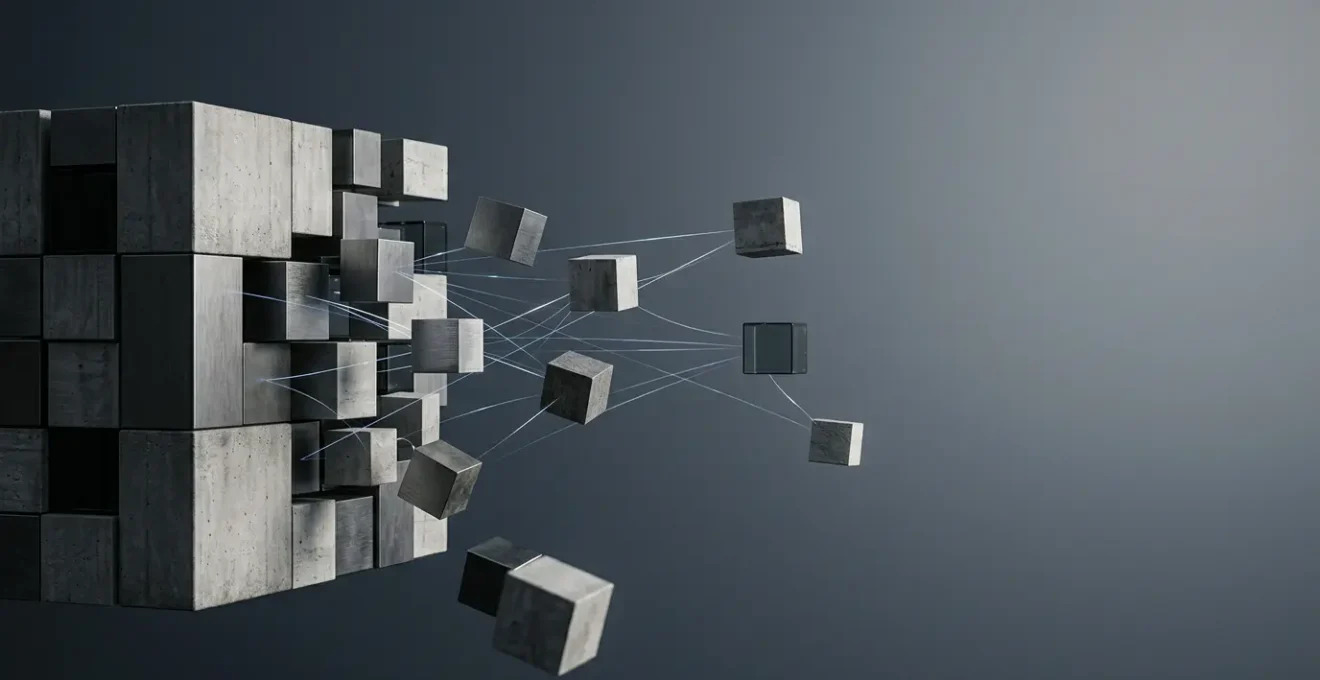
Decoupling a monolithic codebase is not a technology migration; it’s an architectural shift that redefines a system’s relationship with latency, failure, and data consistency.
- Distributed systems are not inherently faster. They trade computational latency for network and serialization latency, which must be rigorously managed within a « latency budget ».
- System resilience is no longer a reactive measure but a proactive design principle, achieved by deliberately engineering for failure within contained « blast radiuses ».
Recommendation: The first step is not to write a new service. It is to implement observability-driven discovery, using production data to map the true service boundaries and dependencies hidden within the monolith.
For Chief Technology Officers and Lead Architects at established UK enterprises, the monolithic codebase is a familiar paradox. It is the engine of the business, yet it is also the anchor holding it back. The scenario is common: a software architecture so massive and entangled that deploying a simple feature requires a multi-month cycle of development, integration, and regression testing. This glacial pace is not a symptom of engineering incompetence; it is a structural inevitability of monolithic design, where every component is tightly coupled, and the blast radius of any change is the entire system.
The common prescription is « microservices. » This term is often presented as a panacea, promising agility, scalability, and resilience. However, this high-level advice glosses over the brutal physics of distributed systems. A transition to a decoupled architecture is not a simple lift-and-shift operation. It demands a fundamental shift in thinking, moving from the predictable, in-process world of the monolith to a chaotic, distributed environment where the network is unreliable, latency is a given, and partial failure is the normal state of operation.
The true challenge is not choosing a tool like Kubernetes or a pattern like Strangler Fig. The challenge is mastering the underlying principles that these tools and patterns are designed to address. It requires treating performance as a finite budget, failure as a design input, and security as a perimeter-less reality. This is not about replacing one technology with another; it’s about re-architecting the very assumptions upon which your software is built to achieve the speed and resilience modern enterprise demands.
This guide provides a structural framework for that process. It deconstructs the core architectural pillars—from performance trade-offs to security models—that must be mastered to successfully dismantle a monolith and unlock the velocity your engineering teams need. We will navigate the critical decisions required at each stage of the decoupling journey.
Summary: A Structural Guide to Decoupling Legacy Enterprise Systems
- Why Assuming Distributed Systems Are Inherently Faster Will Ruin Your App Performance?
- How to Break Down a Giant Legacy Application Into Independent Containerised Functions?
- Kubernetes vs Docker Swarm: Which Orchestrates Thousands of Containers Better?
- The Chained Dependency Flaw Where One Failing Module Takes Down the Entire Application
- Tracking Elusive Bugs Across Hundreds of Distributed Servers Using Centralised Tracing
- Horizontal vs Vertical Resource Expansion: Which Prevents Website Crashes Better?
- GraphQL vs Traditional Architecture: Which Handles Complex Data Queries Faster?
- Building Secure and Efficient Web Interfaces for Enterprise Applications
Why Assuming Distributed Systems Are Inherently Faster Will Ruin Your App Performance?
The first and most dangerous assumption in decoupling a monolith is that distributed systems are inherently faster. They are not. They simply trade one type of latency for another. In a monolith, a call between two modules is an in-memory function call, measured in nanoseconds. In a microservices architecture, that same call becomes a network request, measured in milliseconds. This is a 1,000,000x increase in baseline latency before any real work is done. Ignoring this fundamental shift will lead to catastrophic performance degradation.
This network overhead is compounded by two other critical factors: data serialization and tail latency. Every piece of data sent across the network must first be converted into a transmissible format (like JSON or Protobuf) and then deserialized on the other end. As the GeeksforGeeks Technical Team notes in their analysis of distributed systems, this process of « Data Serialization/Deserialization » is a non-trivial time cost that adds to the overall latency of every single request.
Furthermore, in a system handling thousands of requests per second, average latency is a deceptive metric. The user experience is defined by the outliers. Research on tail latency in distributed systems shows that even if just 1% of requests experience 2+ seconds of latency, it can severely degrade the perceived performance of the entire application. In a distributed system, a single user action might trigger a chain of ten service calls. The probability of one of those calls being a high-latency outlier increases exponentially, making a snappy user experience difficult to guarantee without rigorous architectural controls. The solution is to establish a strict « latency budget » for every user-facing operation and enforce it at the architectural level.
How to Break Down a Giant Legacy Application Into Independent Containerised Functions?
The process of dismantling a monolith is not a demolition; it is a careful, strategic extraction. The initial and most critical phase is identifying the correct « seams » within the application—the logical boundaries that define cohesive domains of functionality. Attempting this based on outdated documentation or institutional memory is a recipe for disaster. The only reliable method is observability-driven domain discovery: using live production data, particularly distributed traces and transaction flows, to map the actual interactions and dependencies between different parts of the monolith.

This data-driven approach reveals the true « service boundaries » as they exist in production. Clusters of tightly coupled database tables and code paths that are frequently called together are strong candidates for extraction as a single, independent service. Once a candidate domain is identified, the Strangler Fig Pattern provides a battle-tested, low-risk strategy for migration. This involves deploying a proxy or API gateway in front of the monolith that intercepts requests. Calls to the functionality being extracted are routed to the new, containerised microservice, while all other requests continue to pass through to the legacy monolith. Over time, more functionality is « strangled » out of the monolith and replaced by new services, until the original application withers away.
Case Study: Migrating a Legacy Order Management System (OMS)
A detailed implementation by Aegis Softtech demonstrates this process on a complex monolithic Order Management System. Using the Strangler Fig pattern, they methodically extracted functionality into discrete microservices like an Order Service, Inventory Service, and Customer Service. The critical part of their success was a careful assessment of dependencies and a phased database migration strategy, adopting a database-per-service model to ensure true decoupling. This prevented the common pitfall of creating « distributed monoliths » where services are independent in code but still coupled by a shared database.
Your Monolith Decoupling Audit Plan
- Points of contact: List all entry points to the monolith (APIs, UI endpoints, batch jobs) where new functionality can be intercepted.
- Collecte: Inventory existing domains by analyzing transaction flows and data access patterns using observability tools. Identify tightly-coupled code and data.
- Cohérence: For a candidate service (e.g., « Invoicing »), verify that its proposed data model does not have undeclared dependencies on other parts of the monolith.
- Mémorabilité/émotion: Define the « seam » for the first service. Is it a clean, logical boundary (e.g., all user profile functions) or a tangled mess? Start with the cleanest boundary.
- Plan d’intégration: Design the routing logic in the API Gateway (the « Strangler ») to transparently redirect traffic for the new service without impacting existing clients.
Kubernetes vs Docker Swarm: Which Orchestrates Thousands of Containers Better?
Once services are broken down into independent, containerised functions, the next architectural challenge is orchestration: managing the deployment, scaling, networking, and health of thousands of containers. The two primary contenders in this space are Docker Swarm and Kubernetes. While Docker Swarm offers simplicity and a gentle learning curve, it is fundamentally outmatched at enterprise scale. For orchestrating a complex, decoupled application with thousands of moving parts, Kubernetes is the de facto industry standard.
Docker Swarm is excellent for smaller-scale deployments. Its tight integration with the Docker CLI makes it easy to set up a cluster and deploy services. However, its capabilities for auto-scaling, self-healing, networking policies, and secrets management are far less sophisticated than those of Kubernetes. Swarm’s model is simpler but lacks the declarative, extensible API that makes Kubernetes so powerful for managing complex application lifecycles.
Kubernetes, while significantly more complex to set up and manage, provides a vastly more robust and flexible platform. Its architecture is built around the concept of a « desired state. » The architect declares the desired state of the application (e.g., « I want 5 replicas of the payment service, accessible at this address, with these resource limits »), and Kubernetes’ control plane works relentlessly to make reality match that declaration. This model provides superior auto-scaling, automated rollouts and rollbacks, and fine-grained control over resource allocation. Its market dominance is not accidental; as research from Edge Delta shows, Kubernetes holds a 92% market share in container orchestration tools. For any serious enterprise decoupling effort, investing in Kubernetes expertise is not optional; it is a prerequisite for operational stability.
The Chained Dependency Flaw Where One Failing Module Takes Down the Entire Application
Decoupling a monolith introduces a new and insidious failure mode: the cascading failure. In a monolithic application, a failure is usually total and obvious. In a distributed system, a minor failure in a non-critical downstream service (e.g., a recommendation engine) can trigger a chain reaction of timeouts and resource exhaustion that brings down the entire user-facing application. A single failing module can create a « thundering herd » of retries, overwhelming the network and causing a complete outage. The system’s resilience is only as strong as its weakest dependency.

To combat this, a modern architecture must be designed for failure. This is not about preventing failure, which is impossible, but about containing its « blast radius. » This is achieved through resilience patterns like Circuit Breakers, Timeouts, and Bulkheads. A circuit breaker wraps a network call to a downstream service. If that service starts failing or timing out, the breaker « trips » and immediately fails subsequent requests without even attempting to make the network call, preventing the failure from cascading. This allows the system to degrade gracefully—the user might see an empty product recommendation panel, but the core checkout functionality remains operational.
The most advanced organizations take this a step further with Chaos Engineering. As the Netflix Engineering Team famously stated, « The best way to avoid failure is to fail constantly. » This philosophy is about proactively and deliberately injecting failure into a production system to find weaknesses before they cause a real outage.
Case Study: Netflix and Chaos Monkey
Netflix pioneered Chaos Engineering by building « Chaos Monkey, » a tool that randomly terminates production instances during business hours. This forced engineers to design their services to be resilient to instance failure from day one. There was no « hoping » an instance wouldn’t fail; failure was a certainty. According to a case study by the Carnegie Mellon Software Engineering Institute, this proactive approach is a key reason why Netflix maintains exceptionally high availability despite running one of the world’s largest and most complex distributed systems. It ensures that the failure of any single component has a minimal and, most importantly, a *predictable* impact on the user experience.
Tracking Elusive Bugs Across Hundreds of Distributed Servers Using Centralised Tracing
In a monolith, debugging is relatively straightforward. A stack trace points to a specific line of code in a single process. In a distributed system composed of hundreds of services, a single user request can trigger a complex chain of calls across dozens of servers. When something goes wrong, the error might not manifest until several services downstream. Pinpointing the root cause is like finding a needle in a haystack, with logs scattered across a fleet of machines. This is where observability and centralised tracing become non-negotiable architectural requirements.
Observability is more than just monitoring. Monitoring tells you *that* something is wrong (e.g., CPU is high). Observability gives you the tools to ask *why*. It is built on three pillars: Metrics, Logs, and Traces. Centralised logging aggregates logs from all services into a single, searchable system. Metrics provide a high-level view of system health. But the true key to debugging distributed systems is the trace. A distributed trace assigns a unique ID to an initial request and propagates that ID through every subsequent service call it triggers. This allows you to reconstruct the entire journey of a single request, viewing the latency and outcome of each step in the chain.
This capability is critical for diagnosing elusive, intermittent bugs and performance bottlenecks. As enterprise observability practitioners emphasize, the goal is « High-Cardinality and High-Dimensionality Analysis, » which means capturing rich, arbitrary context with every event. This allows engineers to « slice and dice » the data in real-time to debug novel problems. It’s no surprise that industry data reveals that 77% of Kubernetes users now employ dedicated observability tools. Without a robust, centralised tracing system, you are essentially flying blind, and the Mean Time to Resolution (MTTR) for production issues will skyrocket, negating the agility gains from decoupling.
Horizontal vs Vertical Resource Expansion: Which Prevents Website Crashes Better?
When a decoupled application faces increased load, preventing crashes requires a robust scaling strategy. There are two fundamental approaches: vertical scaling and horizontal scaling. Understanding the trade-offs between them is critical for designing a cost-effective and resilient system. Vertical scaling (scaling up) means adding more resources (CPU, RAM) to an existing server. Horizontal scaling (scaling out) means adding more servers to a pool of resources.
Vertical scaling is the traditional approach and is often simpler to implement initially. If a database server is struggling, you move it to a larger machine. However, this strategy has significant limitations. There is always a physical upper limit to how large a single machine can be, and the cost increases exponentially. More importantly, vertical scaling does not improve resilience. If that single, massive server fails, the entire service it hosts goes down. This makes it a poor fit for the stateless components of a modern, decoupled architecture.
Horizontal scaling is the cornerstone of cloud-native design. By designing services to be stateless (meaning any instance can handle any request), you can simply add more identical, smaller instances to a cluster to handle increased load. This approach is far more resilient; if one instance fails, the orchestrator (like Kubernetes) simply routes traffic to the healthy ones. It is also more cost-effective, allowing you to use commodity hardware and scale capacity almost infinitely. The explosive growth of the container ecosystem, where the application container market is projected to reach $31.50 billion by 2030, is a direct result of the superiority of this model. As experts in Cloud Architecture Best Practices state, the modern strategy is not a binary choice: « Vertical scaling for stateful monoliths, horizontal scaling for stateless containerised functions. »
GraphQL vs Traditional Architecture: Which Handles Complex Data Queries Faster?
Decoupling an application solves many problems, but it creates a new one: data fetching complexity. In a monolith, a web interface can get all the data it needs with a few complex SQL queries. In a microservices world, that same data might be spread across ten different services (User Service, Product Service, Inventory Service, etc.). The traditional REST approach would require the client application (e.g., a mobile app) to make ten separate API calls, stitch the data together, and handle ten different failure modes. This is slow, inefficient, and places a huge burden on front-end developers.
This is the exact problem that GraphQL was designed to solve. GraphQL is not a replacement for REST; it’s a query language for your API that acts as a powerful abstraction layer. Instead of providing dozens of rigid endpoints, you expose a single, intelligent GraphQL endpoint. The client can then send a single query that describes exactly the data it needs, including nested data from different underlying services. As stated by Modern API Architecture Experts, « GraphQL’s primary enterprise use case is as a Backend-for-Frontend (BFF) » that handles the complexity of querying multiple services and stitching the data into a single, cohesive response. This dramatically simplifies client-side logic.
This BFF pattern allows the front-end team to move quickly, requesting new data combinations without requiring any changes to the back-end services. The GraphQL server becomes a dedicated aggregation layer, responsible for the complex orchestration of calling multiple downstream REST APIs, transforming the data, and returning it in the exact shape the client asked for. This eliminates the problems of over-fetching (getting more data than needed) and under-fetching (having to make multiple calls) that plague traditional REST APIs in a distributed environment, resulting in faster and more efficient web interfaces.
Key Takeaways
- Decoupling is an architectural discipline, not a technology choice. Success hinges on mastering latency, failure, and data consistency.
- The Strangler Fig pattern, guided by observability data, provides the safest, most effective path to incrementally dismantle a monolith.
- Resilience is not optional. Proactive failure testing (Chaos Engineering) and patterns like circuit breakers are mandatory for preventing cascading outages.
Building Secure and Efficient Web Interfaces for Enterprise Applications
In a monolithic architecture, security is often simplified to a « castle-and-moat » model: a strong perimeter firewall protects a trusted internal network. Once an application is decoupled into dozens or hundreds of services communicating over a network, this model becomes dangerously obsolete. The attack surface expands exponentially, and the concept of a « trusted internal network » ceases to exist. Every service-to-service call is a potential security vulnerability. This reality has made the adoption of a Zero Trust security model an architectural imperative.
The core principle of Zero Trust is « never trust, always verify. » No communication is trusted by default, regardless of its origin. As Zero Trust Architecture Advocates put it, « Every service-to-service call must be authenticated via mTLS and authorized using token-based credentials, with an API Gateway enforcing fine-grained access policies. » In practice, this is often implemented using a service mesh (like Istio or Linkerd), which provides mutual TLS (mTLS) to encrypt all traffic between services automatically and enforce identity-based access control.
This granular, identity-based security is critical, as security concerns are a major roadblock to modernization. A recent Red Hat report found that 67% of organizations have delayed or slowed application deployment due to container or Kubernetes security concerns. An API Gateway plays a central role in this architecture, acting as a single, fortified entry point for all external traffic. It is responsible for terminating TLS, authenticating users, validating JWT tokens, and enforcing rate limiting and other security policies before a request is ever allowed to reach an internal service. This layered, defense-in-depth approach is the only way to build secure and efficient interfaces in a distributed world.
Successfully navigating the transition from a monolithic architecture to a decoupled one is among the most challenging and rewarding tasks in modern software engineering. It demands a shift from a deterministic mindset to a probabilistic one, where architects build systems that are not just robust but actively anti-fragile. By mastering the core principles of latency management, failure containment, and zero-trust security, you provide your engineering teams with the structural foundation they need to finally break free from legacy constraints and deliver value at the speed the business demands. The path is complex, but the outcome—an agile, resilient, and scalable enterprise platform—is the ultimate competitive advantage.