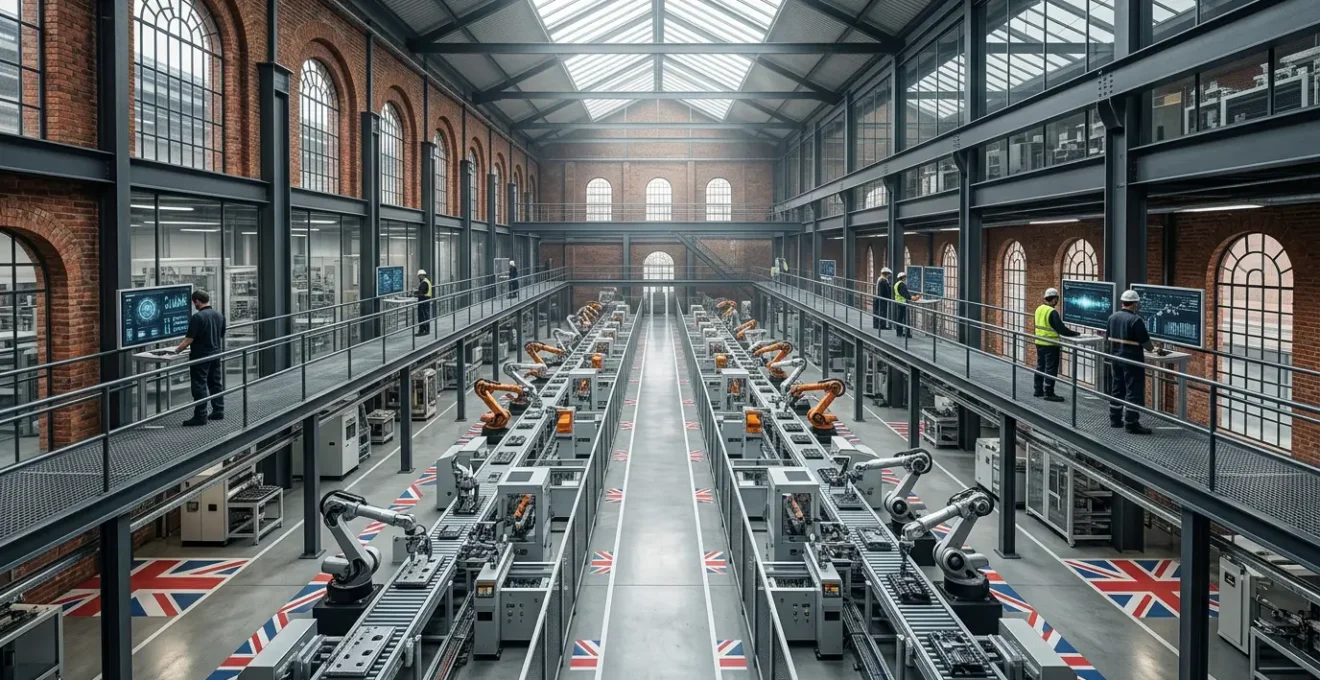
The key to modernising your legacy UK factory isn’t securing one massive loan, but sequencing a series of smaller, self-funding operational upgrades.
- Shift focus from Capital Expenditure (CapEx) to Operational Expenditure (OpEx) models like Robotics-as-a-Service (RaaS) to preserve cash flow.
- Leverage targeted government grants and initial energy savings to fund the first technology pilots, creating a snowball effect.
Recommendation: Start by identifying one specific, high-impact inefficiency on your factory floor that can be solved with a low-cost sensor or software pilot to demonstrate immediate ROI.
For owners and directors of traditional British manufacturing plants, the pressure to modernise is immense. The term « Industry 4.0 » echoes in boardrooms, a constant reminder of the automated, data-driven future that seems to be pulling away. You know you must invest in smart factory technology to remain competitive, reduce energy costs, and build resilience. The common advice often revolves around securing massive capital loans or navigating the labyrinthine world of corporate finance, creating a daunting barrier to entry. Many leaders feel paralysed, stuck between the high cost of investment and the even higher cost of inaction.
But what if this « all or nothing » approach is a misconception? What if the path to a smart factory isn’t a single, terrifying leap but a series of calculated, manageable steps? The true strategy for legacy facilities lies not in finding massive upfront capital, but in reframing the entire modernisation project. The key is to stop thinking in terms of a monolithic capital expenditure and start executing a sequence of smaller, cash-flow-positive operational upgrades. Each step—from installing energy-monitoring sensors to leasing a collaborative robot—can generate immediate efficiency gains that fund the next stage of transformation.
This article provides a practical, financially astute roadmap for this very process. We will break down how to secure initial funding through grants, demonstrate rapid ROI to sceptical stakeholders, and use asset-light models to upgrade your technology without draining your balance sheet. It’s time to move from a state of paralysis to a position of proactive, incremental modernisation.
To navigate this complex but achievable transformation, this guide breaks down the financial and strategic steps into a clear, actionable sequence. Below is the table of contents that will serve as your roadmap to a self-funding factory upgrade.
Summary: A Practical Guide to Financing Smart Factory Upgrades in the UK
- Why Delaying Smart Factory Investments Increases Energy Waste by 25%?
- How to Secure Government Grants for IoT Sensor Implementation Projects?
- Leasing Robotics vs Capital Expenditure: Which Preserves Cash Flow Better?
- The Pilot Purgatory Trap That Prevents Successful Tech Rollouts Factory-Wide
- Demonstrating Rapid ROI to Sceptical Board Members Using Initial Efficiency Gains
- How to Build Supply Chain Resilience Without Increasing Inventory Overhead?
- How to Connect 20-Year-Old Presses to Cloud Analytics Platforms?
- Upgrading Legacy UK Plants Into Fully Automated Production Centres
Why Delaying Smart Factory Investments Increases Energy Waste by 25%?
The most compelling argument for immediate action is often the hidden cost of inaction. For legacy manufacturing facilities, this cost is most visible on your monthly energy bill. Outdated machinery, inefficient processes, and a lack of real-time monitoring create a significant and continuous financial drain. While the title suggests a 25% increase, the reality can be even more stark. The first step in building a business case for Industry 4.0 is to quantify this waste and present the savings not as a future goal, but as immediate revenue being lost every day.
Smart sensors are the gateway to this understanding. By deploying IoT devices to monitor machine states, temperature, and power consumption, you can quickly identify the primary sources of energy waste. This could be machinery left idling between shifts, compressed air leaks, or inefficient heating and cooling cycles. The data collected provides a clear, undeniable baseline of your current operational inefficiency. This isn’t abstract; it’s tangible money disappearing from your bottom line.
The potential savings are not trivial. For example, a case study from a multinational plastics manufacturer demonstrates that a strategic implementation of Industry 4.0 sensors can lead to a 40% reduction in power consumption, saving over $200,000 annually. This saving is the seed capital for your entire transformation. By framing the initial investment in sensors as a project that pays for itself within months, you transform a capital request into a self-liquidating operational improvement. It’s the first, most critical step in creating a self-funding upgrade cycle.
How to Secure Government Grants for IoT Sensor Implementation Projects?
Once you’ve identified the potential for energy savings, the next step is to secure the initial, low-risk capital to launch your first pilot project. For UK manufacturers, government grants are a powerful and often underutilised tool. Organisations like Innovate UK exist specifically to de-risk these kinds of digital transformation initiatives. However, securing a grant requires more than just filling out a form; it requires strategic positioning.
The key is to frame your project not just as a benefit to your company, but as a contribution to national strategic goals. Are you enhancing UK manufacturing sovereignty? Reducing the carbon footprint to help meet Net-Zero targets? Creating or safeguarding jobs in the digital economy? Aligning your project with these broader objectives significantly strengthens your application. Furthermore, forming a consortium with a local university or a tech start-up demonstrates collaboration and adds academic and technical weight to your proposal, a factor highly valued by funding bodies.

The funding available is substantial. For instance, Innovate UK’s latest Smart Grant round offers £25 million available for SMEs, with the potential for up to 70% of project costs to be funded. Specific schemes like the Made Smarter programme offer match funding up to £20,000, which is often the perfect amount for an initial IoT sensor implementation. To succeed, your application must clearly demonstrate ‘additionality’—the argument that the project could not proceed at the same scale or speed without the grant. This proves to the government that their investment is making a tangible difference.
Your Action Plan: Securing UK Manufacturing Grants
- Frame your project as solving national challenges (e.g., ‘Enhancing UK Manufacturing Sovereignty’).
- Form a consortium with universities or tech start-ups to strengthen your Innovate UK application.
- Start with a self-funded micro-pilot to generate preliminary data that de-risks your main grant application.
- Target specific funding streams like Made Smarter for digital transformation match funding.
- Ensure your application clearly demonstrates ‘additionality’—why the project needs the grant to happen.
Leasing Robotics vs Capital Expenditure: Which Preserves Cash Flow Better?
As you move beyond data collection and into physical automation, the question of financing becomes even more critical. The traditional mindset of purchasing a £150,000 robotic arm—a massive Capital Expenditure (CapEx)—is often what stalls modernisation plans. This is where a fundamental shift in financial thinking is required. The modern, asset-light approach prioritises cash flow preservation through leasing and « as-a-service » models.
The most transformative of these is Robotics-as-a-Service (RaaS). Unlike a traditional purchase or even a standard lease, RaaS treats automation like a utility. You don’t buy the robot; you pay for the work it does, often by the hour or by the task. This model moves the entire cost from a CapEx on your balance sheet to a predictable Operational Expenditure (OpEx). There is no large upfront cost, maintenance and software updates are included, and you gain the flexibility to scale your automation up or down as demand fluctuates. It is the ultimate expression of an OpEx shift.
This approach completely changes the financial conversation. Instead of asking the board for a huge capital outlay with a 3-5 year payback period, you are presenting a manageable monthly operating cost that delivers immediate productivity gains. The comparison between these models makes the cash flow argument undeniable. The following table, based on recent industry analysis, breaks down the core differences.
| Aspect | Robotics-as-a-Service (RaaS) | Traditional Leasing | Capital Purchase |
|---|---|---|---|
| Upfront Cost | None – Pay per use/hour | Low – Initial deposit | High – Full purchase price |
| Balance Sheet Impact | Off-balance sheet (OpEx) | On-balance sheet liability | Deprecating asset |
| Maintenance | Included in subscription | Customer responsibility | Customer responsibility |
| Technology Updates | Automatic upgrades included | Fixed technology | Requires new purchase |
| Flexibility | Scale up/down monthly | Fixed term commitment | No flexibility |
As Unite.ai’s industry analysis highlights, leading robotics companies are increasingly embracing this model. Rather than selling robots outright, they retain ownership and deliver them as a managed service. For a legacy manufacturer, this de-risks the adoption of new technology and makes advanced automation accessible without crippling capital investment.
The Pilot Purgatory Trap That Prevents Successful Tech Rollouts Factory-Wide
You’ve secured a grant. You’ve run a successful pilot project on one machine, maybe showing a 15% efficiency gain. The team is excited. But then… nothing happens. The project never scales. The technology remains isolated in one corner of the factory while the rest of the facility operates as it always has. This is the « Pilot Purgatory » trap, and it is where the majority of digital transformations in manufacturing fail.
The primary cause of this trap is a lack of a strategic, factory-wide rollout plan from day one. Companies become what McKinsey terms « frustrated experimenters. » They deploy technologies piecemeal, without a clear understanding of how to connect the initial success of a pilot to a tangible, financial ROI for the entire business. A successful pilot proves a technology *can* work, but it doesn’t automatically create the business case for a full-scale deployment.
Escaping this trap requires a strategic, top-down approach before the first pilot even begins. This is the difference between experimenting and executing a transformation.
McKinsey’s Roadmap to Escape Pilot Purgatory
According to McKinsey’s analysis of manufacturing transformations, leading companies avoid this trap by architecting a laser-focused digital manufacturing strategy *before* deployment. This involves two key phases. First, a comprehensive network scan to identify high-leverage areas across the entire value chain and create a priority list of technology use cases. This answers the question, « Where will technology create the most value? » Second, they create an accompanying deployment roadmap. This defines not just the initial pilot site but also a clear, phased, network-wide rollout plan to achieve scale. This structured approach ensures that every successful pilot has a pre-approved path to becoming a factory-wide standard.
Without this roadmap, each new phase of expansion requires a new round of approvals, a new budget fight, and a new business case. The initial momentum is lost, and the transformation stalls. Your first pilot should not be an experiment; it should be Step One of a pre-defined, multi-step plan.
Demonstrating Rapid ROI to Sceptical Board Members Using Initial Efficiency Gains
Even with a solid plan, the board of directors will ultimately judge your Industry 4.0 initiative on one thing: Return on Investment (ROI). The mistake many operations leaders make is focusing solely on long-term, lagging indicators like cost savings, which may take years to fully materialise. To win over sceptical stakeholders and maintain momentum, you must build a compelling ROI story based on rapid, demonstrable, and holistic efficiency gains from your very first pilot projects.
This means shifting the conversation beyond simple cost-out metrics. While a reduction in energy bills is a great start, a truly powerful ROI case includes leading indicators and non-traditional value metrics. Smart factory dashboards can track these in real-time: improvements in Overall Equipment Effectiveness (OEE), reductions in cycle time, and increases in first-pass yield. These are immediate, data-driven proofs that the new technology is working and creating value *right now*. This data provides the narrative to justify further investment.

Furthermore, as research from EY points out, a holistic ROI story should also quantify benefits that don’t traditionally appear on a balance sheet. For example, did automating a repetitive, physically demanding task lead to a measurable reduction in staff turnover for that department? Did the improved process control enhance your ESG (Environmental, Social, and Governance) score, which can be crucial for attracting investors and customers? Can you quantify the value of risk mitigation by preventing a costly machine failure? These qualitative-turned-quantitative metrics paint a much richer picture of the project’s true value, resonating more deeply with a board focused on the overall health and resilience of the business.
How to Build Supply Chain Resilience Without Increasing Inventory Overhead?
The disruptions of recent years have made supply chain resilience a top priority for every UK manufacturer. The traditional response to uncertainty has been to increase inventory—creating a physical buffer of raw materials and finished goods. However, this « just-in-case » approach ties up valuable cash, requires expensive warehouse space, and increases the risk of obsolescence. Industry 4.0 offers a more intelligent, data-driven solution: building digital resilience rather than physical buffers.
The core of this strategy is transparent, real-time data sharing between your production operations and your key suppliers. When your supply chain is integrated with your factory floor, you can transform how you manage resources. For example, if your assembly line experiences an unexpected stoppage, an integrated system can automatically alert your tier-1 suppliers to delay their next delivery. This simple act of communication prevents materials from arriving too early, reducing wasted time, demurrage costs, and on-site congestion.
This connectivity also allows for more sophisticated strategies like predictive shipping. By analysing a combination of your own production data, weather patterns, logistics partner data, and even retailer point-of-sale information, you can anticipate demand with far greater accuracy. This enables you to ship finished goods at precisely the right moment to meet consumer demand, avoiding both stock-outs and costly over-production. In this model, data becomes your buffer, replacing the need for excess physical inventory. This is a critical component of building a lean, resilient, and cash-efficient manufacturing operation.
How to Connect 20-Year-Old Presses to Cloud Analytics Platforms?
A major psychological barrier for legacy manufacturers is the sight of their factory floor, filled with reliable but seemingly « dumb » 20-year-old machines. The assumption is that you need to replace this entire fleet of equipment to build a smart factory. This is a myth. The reality is that you can bring your legacy assets into the digital age through a process called retrofitting.
The first and most crucial piece of advice comes from the L2L Smart Factory Implementation Guide:
Start with ‘data logging’ before ‘data analytics’. The first step is simply to capture data, even if it’s messy.
– L2L Smart Factory Implementation Guide
This means you don’t need a perfect, fully integrated system from day one. The initial goal is simply to start extracting data from your existing machinery. There are several ways to achieve this, ranging from simple, non-invasive methods to more integrated solutions.
The approach you choose depends on your budget and the level of data fidelity you require. A ‘Good’ starting point involves non-invasive external sensors that monitor acoustics, vibration, or power consumption. A ‘Better’ approach taps into the machine’s existing Programmable Logic Controller (PLC). The ‘Best’ and most robust method uses a dedicated edge gateway to translate proprietary legacy protocols into modern, cloud-friendly formats like MQTT.
| Approach | Method | Cost Range | Implementation Time | Data Quality |
|---|---|---|---|---|
| Good | Non-invasive external sensors (acoustic, thermal, power) | £5,000-15,000 | 1-2 weeks | Basic operational insights |
| Better | Tapping into existing PLC I/O | £15,000-30,000 | 2-4 weeks | Detailed operational data |
| Best | Edge gateway with protocol conversion | £30,000-50,000 | 4-6 weeks | Full integration with legacy control systems |
However, connecting Operational Technology (OT) to Information Technology (IT) introduces new cybersecurity risks. It is essential to approach this with a security-first mindset, implementing critical mitigation steps like network segmentation (creating « air gaps » between critical systems and the wider network) and specific OT security monitoring solutions to prevent creating new vulnerabilities.
Key Takeaways
- The cost of inaction, particularly in energy waste, is often greater than the cost of a small, initial smart factory investment.
- Shift your financial mindset from large, risky Capital Expenditures (CapEx) to manageable, flexible Operational Expenditures (OpEx) through leasing and « as-a-service » models.
- Avoid « Pilot Purgatory » by having a factory-wide rollout plan before you begin, ensuring every successful pilot has a clear path to scale.
Upgrading Legacy UK Plants Into Fully Automated Production Centres
The journey from a traditional plant to a fully automated production centre is a marathon, not a sprint. The ultimate vision isn’t necessarily a « lights-out » factory devoid of people. Instead, it’s about creating a collaborative environment where human ingenuity is augmented by the precision, endurance, and data-processing power of automation. This final stage of transformation is about elevating your workforce, not replacing it.
A recent milestone in this evolution was the 2024 agreement between BMW and Figure AI to deploy humanoid robots in an automotive production plant. This represents a significant shift from ‘automation’ to ‘augmentation’. The goal is to integrate these robots as a managed service to handle repetitive, strenuous, or dangerous tasks. This frees human workers to focus on higher-value roles: process supervision, quality control, data analysis, and creative problem-solving. It creates a collaborative robot workforce that enhances human capability.
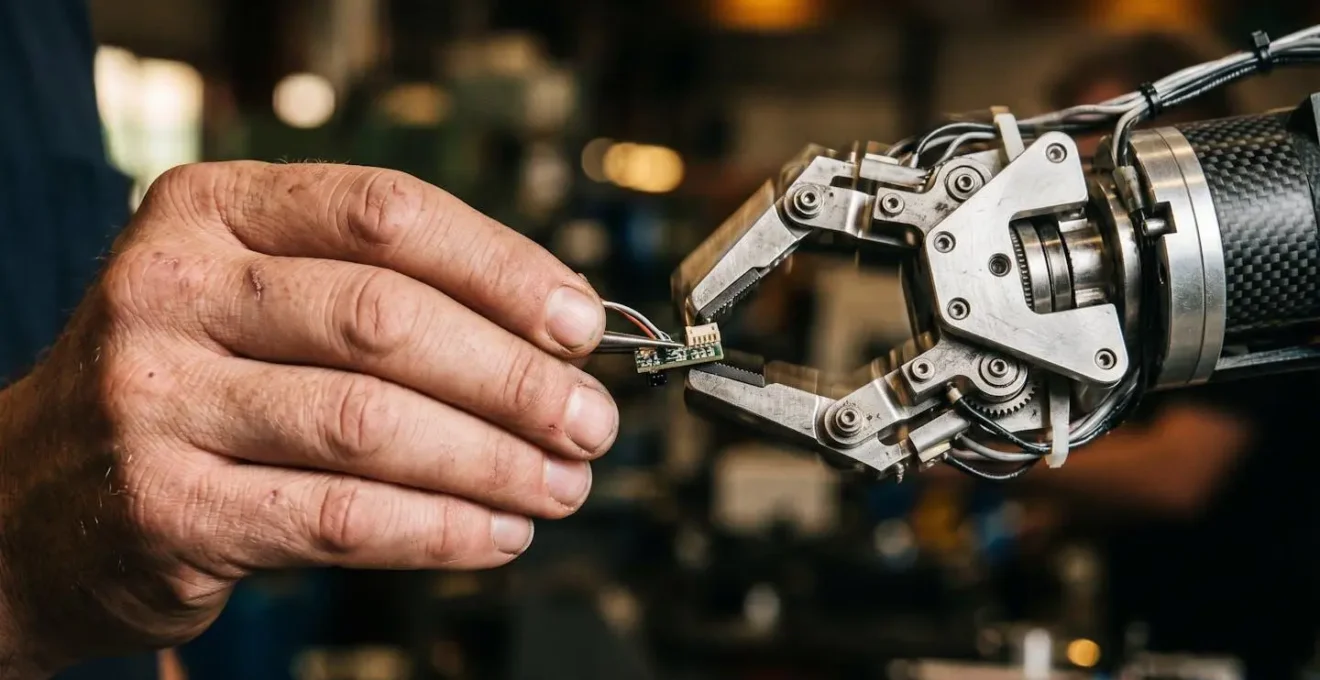
This vision cannot be realised without a parallel investment in people. A skills transformation roadmap is just as critical as your technology roadmap. This involves mapping your current workforce’s skills to identify digital competency gaps, then partnering with UK technical colleges to create customised training and apprenticeship schemes. Creating ‘Digital Champions’ within each department and establishing ‘learning factories’ where workers can practice with new technologies in a risk-free environment are essential tactics. The goal is to create clear career progression paths that lead from a traditional machine operator to a highly skilled robotics technician or data interpreter.
By following this incremental, financially astute, and human-centric approach, upgrading your traditional UK manufacturing facility is not only possible but can become a self-funding engine for growth and resilience. The next logical step is to begin your own network scan: identify the single biggest point of inefficiency in your plant and start building the business case for your first, small-scale pilot project.