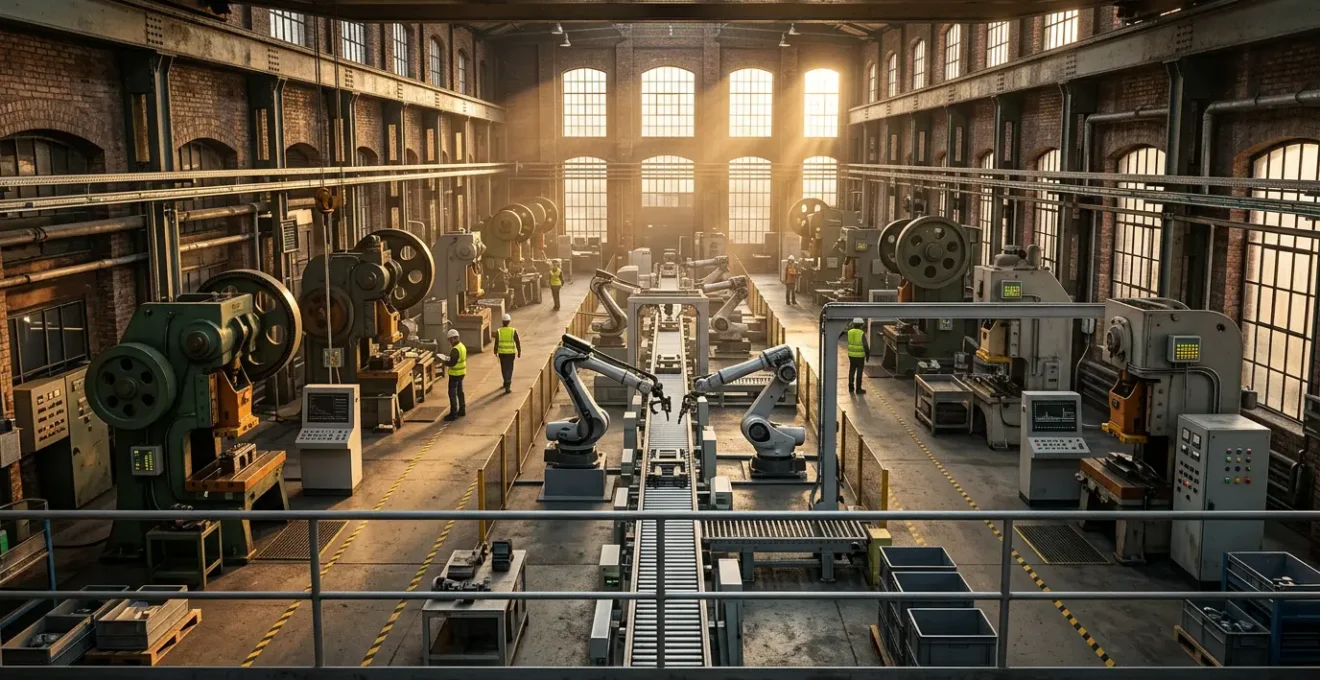
True factory automation is not about replacing your trusted legacy machinery, but about giving it a digital nervous system to unlock its full potential.
- Legacy systems, even those decades old, can be retrofitted with modern sensors to connect them to plant-wide analytics.
- A phased, strategic rollout that targets key bottlenecks prevents disruptive downtime and builds operational momentum.
Recommendation: Begin by mapping your existing data silos and production bottlenecks, not by shopping for new robotic systems.
Your factory floor is a testament to British manufacturing endurance. For decades, its presses, conveyors, and assembly lines have been the backbone of your output. Yet, you feel the mounting pressure of rising energy costs, global competition, and a persistent skills gap. The call to modernise grows louder every day, but the prospect of a complete technological overhaul is, frankly, intimidating.
The common advice often feels like a binary choice: either engage in a « rip and replace » strategy—a daunting and costly prospect that threatens precious uptime—or do nothing and risk being left behind. Many consultants speak vaguely of ‘Industry 4.0’ and ‘digital transformation’, presenting glossy brochures of futuristic factories that seem a world away from the reliable, albeit aging, equipment you depend on.
The paradigm shift required is this: your legacy assets are not a liability; they are the foundation. The real goal is to weave them into a single, intelligent ‘digital nervous system’ that gives you total visibility and control. It’s about augmenting, not just replacing. It’s about transforming isolated pockets of activity into a cohesive, productive organism where data flows as freely as the products on your line. This is not science fiction; it is a structured, achievable engineering project.
This strategic blueprint will guide you through the process, step-by-step. We will deconstruct the common failures, provide a clear methodology for connecting old machinery to new software, navigate the critical choices in data architecture, and finally, outline intelligent ways to finance this essential evolution. This is the path to transforming your plant into a true centre of automated production excellence.
This article provides a structured roadmap for factory owners and directors. It breaks down the complex journey of digital transformation into manageable, strategic stages, from initial diagnosis to financial planning.
Summary: A Strategic Blueprint for Smart Factory Transformation
- Why Isolated Automated Machines Fail to Improve Overall Plant Output?
- How to Connect 20-Year-Old Presses to Cloud Analytics Platforms?
- Edge Computing vs Cloud Processing: Where Should Floor Data Reside?
- The Network Latency Flaw That Causes Robotic Assembly Collisions
- In What Order Should You Digitise Production Zones Without Stopping Output?
- Automated Conveyors vs Autonomous Mobile Robots: Which Clears Jams Faster?
- Why Delaying Smart Factory Investments Increases Energy Waste by 25%?
- Financing Industry 4.0 Upgrades for Traditional British Manufacturing Facilities
Why Isolated Automated Machines Fail to Improve Overall Plant Output?
The core reason is that they create highly efficient « islands of automation » in a sea of systemic inefficiency. A new, lightning-fast CNC machine might produce parts at double the old rate, but if the downstream finishing station can’t keep up, or if the upstream material supply is inconsistent, the new machine simply creates a bigger bottleneck. You haven’t increased overall plant output; you’ve just moved the problem and increased work-in-progress inventory. The plant’s total productivity is dictated by its weakest link, not its strongest.
Without a holistic data connection, these islands cannot communicate. The fast machine doesn’t know the downstream station is overwhelmed, and managers only find out when pallets of unfinished parts pile up. This lack of real-time visibility prevents proactive decision-making. True efficiency gains come from synchronising the entire production flow, making each stage aware of the others’ status, capacity, and needs. This is the fundamental shift from machine-level optimisation to system-level optimisation.
The evidence for a connected approach is compelling. A focus on system-wide analytics and connectivity can yield significant results; reports show that manufacturers using connected analytics achieve up to a 30% increase in output capacity. This isn’t from making any single machine faster, but from making the entire system smarter. Consider the case of Tyson Foods, which faced disruptions from unreliable legacy systems. Instead of a full replacement, they integrated their existing infrastructure with cloud platforms and IoT sensors, creating a unified data environment that modernised their operations without starting from scratch.
How to Connect 20-Year-Old Presses to Cloud Analytics Platforms?
The misconception that legacy equipment cannot be part of a smart factory is one of the biggest barriers to modernisation. You do not need to replace a 20-year-old press that is mechanically sound. Instead, you can give it a voice by creating a « digital wrapper » around it. This involves retrofitting the machine with modern, non-invasive sensors to capture critical operational data: vibration sensors to predict mechanical failures, thermal cameras to monitor for overheating, and current clamps to measure energy consumption and workload.
These sensors act as the machine’s new senses, translating its physical state into a stream of digital data. This data is then collected by a small, on-site « edge computing » device. This device preprocesses the information, filtering out noise and sending only relevant insights to the cloud. This approach is highly effective; after all, the typical legacy manufacturing equipment is over 20 years old, making retrofitting a far more common and pragmatic strategy than replacement.
Visualising this marriage of old and new is key. The robust, proven mechanics of your existing machinery are augmented, not discarded, gaining the intelligence of modern technology.
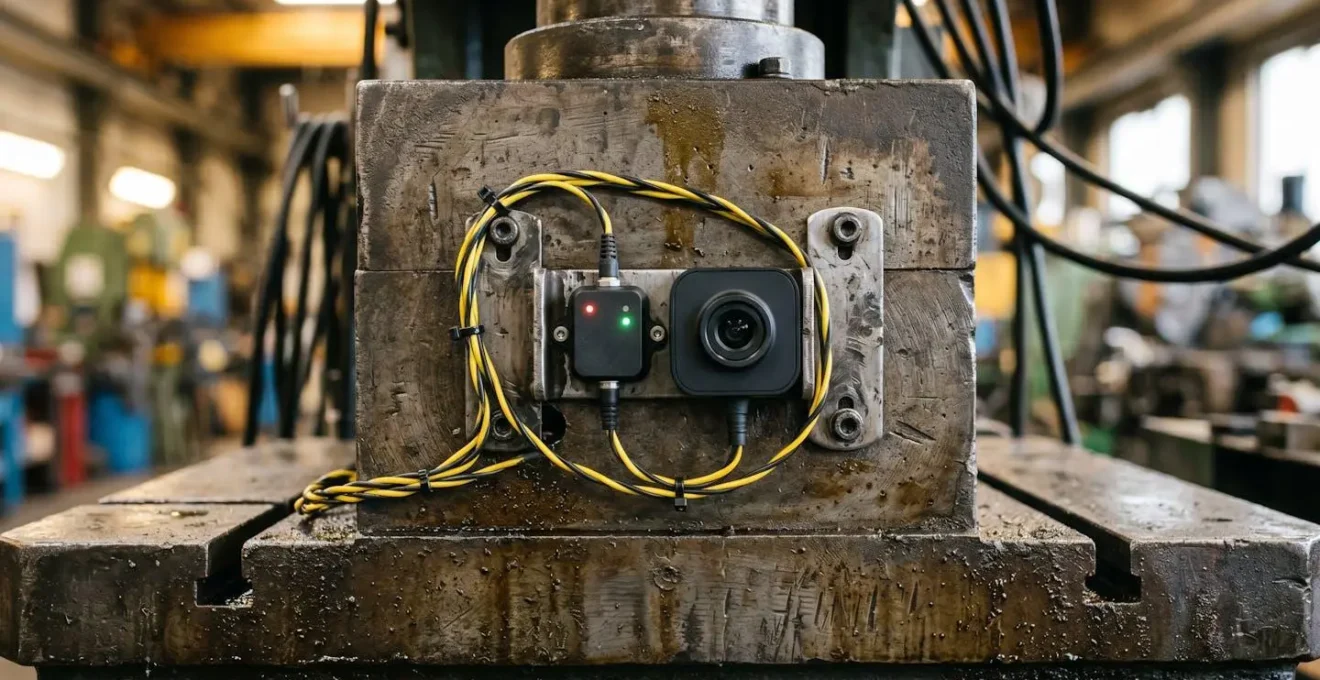
As this image illustrates, the process is about a seamless integration of robust industrial history with state-of-the-art digital capability. The value is not in the sensor itself, but in the data it unlocks from the asset you already own. This data, once fed into a cloud analytics platform, can reveal patterns, predict downtime, and optimise performance in ways that were previously impossible.
Edge Computing vs Cloud Processing: Where Should Floor Data Reside?
The question isn’t about choosing one over the other; it’s about leveraging a hybrid strategy where each technology plays to its strengths. Data processing for your factory should reside in two places: at the « Edge » (close to the machines) for immediate needs, and in the « Cloud » for deep analysis and long-term storage. Think of it as the factory’s reflex versus its memory and intelligence.
Edge Computing is for real-time decisions. When a robotic arm’s safety sensor is triggered, you need an instantaneous « stop » command, not one that travels to a data centre and back. The Edge handles tasks where milliseconds matter: immediate safety interlocks, high-speed quality control, and initial data filtering to reduce network traffic. This local processing ensures that critical operations are never dependent on an internet connection.
Cloud Processing is for strategic oversight. Once the Edge has processed the immediate data, it sends a refined summary to the cloud. Here, powerful platforms can aggregate data from across your entire plant—or even multiple facilities—to perform complex analytics. This is where you identify slow-burning trends, compare shift performance, run predictive maintenance algorithms, and build a comprehensive picture of your Overall Equipment Effectiveness (OEE). Over half of UK manufacturers report having embedded multiple such technologies, highlighting the move toward this integrated model. Rehrig Pacific, for instance, successfully used an edge-to-cloud pipeline to centralise data from legacy equipment, enabling real-time analytics across seven of its factories.
The Network Latency Flaw That Causes Robotic Assembly Collisions
Network latency is the silent saboteur of multi-robot systems. It’s the tiny, often unpredictable, delay between when a signal is sent and when it’s received. While a delay of 50 milliseconds is unnoticeable to a human, for two high-speed robotic arms operating in close proximity, it can be the difference between a perfectly synchronised task and a catastrophic collision. This is not about network bandwidth (how much data you can send), but about jitter and determinism—the consistency and predictability of the delay.
Standard enterprise IT networks are not designed for this level of precision. They are built to handle emails and file transfers, where a slight delay is irrelevant. On the factory floor, a surge in network traffic from a security camera could momentarily delay a robot’s position data, causing it to act on outdated information. This risk becomes more acute as automation density increases, and while the UK has just 119 robots per 10,000 workers—below the global average—this number is rapidly growing, making network integrity a critical safety and operational issue.
The solution lies in purpose-built industrial networks, often incorporating technologies like Time-Sensitive Networking (TSN), which guarantee message delivery within a predictable timeframe. However, before any major investment, a thorough audit of your existing infrastructure is the first and most critical step to identifying and mitigating these invisible risks.
Checklist for Auditing Your Network for Robotic Safety
- Points of contact: List all devices involved in coordinated motion (robot controllers, PLCs, safety sensors, vision systems).
- Collecte: Inventory existing network hardware (switches, routers) and measure baseline latency and packet loss during peak production.
- Cohérence: Compare your measured network jitter against the robot manufacturer’s maximum tolerance specifications.
- Mémorabilité/émotion: Identify and isolate high-bandwidth, non-critical traffic (like CCTV) onto a separate network from time-sensitive robot controls.
- Plan d’intégration: Develop a prioritised plan to upgrade switches or segment the network in zones where measured latency exceeds safety thresholds.
In What Order Should You Digitise Production Zones Without Stopping Output?
The most effective approach to digitisation is not a factory-wide blitz but a phased, strategic rollout that functions like a series of targeted surgical interventions. The process should always follow a « diagnose, then prescribe » model, starting with the area that offers the greatest potential return by solving the most significant pain point. Rushing to digitise the « easiest » or « newest » zone is a common mistake; instead, your first project should target your biggest, most painful bottleneck.
Start by identifying this primary constraint. Is it machine changeover times in the packing area? Unplanned downtime in the milling section? Quality control failures in assembly? This is your starting point. Focus all initial efforts on instrumenting, analysing, and optimising this single zone. This focused approach provides several advantages: it minimises risk, contains the project scope, and allows your team to learn and build confidence. Crucially, a successful first project creates a powerful internal case study, building momentum and securing buy-in for subsequent phases. The story of Georgia-Pacific’s transformation highlights this wisdom; their journey began not with technology, but by sitting down with senior operators to understand their biggest operational challenges firsthand.
As you gather data from this pilot zone, you can begin building a digital twin—a virtual model of your process. This allows you to simulate changes and test optimisation strategies without disrupting live production, de-risking future improvements.

This image of engineers using a digital twin alongside live data represents the ultimate goal: a control room where you can see, simulate, and optimise your entire operation. But this journey begins with one zone, one problem, and one successful solution. With automation technologies expected to reach near-universal adoption, the question is not *if* you will digitise, but *how* you will do so intelligently.
Automated Conveyors vs Autonomous Mobile Robots: Which Clears Jams Faster?
When it comes to internal logistics and material flow, the choice between traditional conveyors and Autonomous Mobile Robots (AMRs) is a decision between fixed infrastructure and flexible intelligence. While conveyors offer immense throughput, their greatest weakness is a single point of failure. A jam on a conveyor line often brings the entire line—and potentially a significant portion of your plant—to a complete standstill until it is manually cleared. An AMR, faced with an obstruction, simply reroutes itself. This fundamental difference in resilience is a critical factor in overall plant uptime.
AMRs introduce a level of dynamism and redundancy that fixed conveyors cannot match. They can be deployed, scaled, and reprogrammed far more easily, adapting to changes in factory layout or production priorities. This is particularly relevant for the many UK SMEs who are at the beginning of their automation journey; it is estimated that 20,000 of 27,000 SMEs currently operate without robots, and a scalable solution like AMRs presents a lower barrier to entry than overhauling the facility with fixed conveyors.
However, the choice is not always binary. High-volume, predictable routes may still be best served by conveyors, while AMRs handle variable or complex tasks. The optimal solution often lies in a hybrid model, using each technology where it provides the most value. The following table provides a clear comparison of their key attributes.
| Factor | Traditional Conveyors | AMRs | Hybrid Model |
|---|---|---|---|
| Jam Recovery Time | 15-30 minutes | Instant rerouting | 5-10 minutes |
| System Impact of Single Failure | Complete line halt | Minimal (others reroute) | Localized only |
| Flexibility | Fixed paths | Dynamic routing | Best of both |
| Throughput Capacity | Very High | Moderate | High |
| Implementation Cost | High upfront | Scalable | Moderate |
Why Delaying Smart Factory Investments Increases Energy Waste by 25%?
The 25% figure in the title represents the compounding cost of inefficiency. Every day an operation continues without optimised control is a day of wasted energy, materials, and time. Delaying investment in smart factory technology is not a neutral act of saving money; it is an active decision to continue incurring these hidden-but-significant costs. Inefficient machines that are not monitored run longer than necessary, consume power when idle, and produce more scrap that requires energy to rework or dispose of.
A smart factory approach tackles this waste head-on. By deploying sensors and analytics, you gain the visibility to see precisely where energy is being consumed. You can identify machines that are running inefficiently, compressed air systems with costly leaks, and HVAC systems heating or cooling unoccupied spaces. This granular data allows for targeted interventions that have a dramatic and immediate impact on the bottom line. It’s about shifting from a reactive, « pay the bill » mindset to a proactive, « manage the consumption » strategy.
The results from companies that have embraced this are stark. For example, analysis of the Global Lighthouse Network plants achieve an average 27% reduction in unit energy costs. The AstraZeneca case study is another powerful example; after scaling digital and AI across their sites, they reported a 55% increase in output while simultaneously reducing lead times by 44%. This demonstrates that efficiency and productivity are two sides of the same coin. The investment is not just about producing more; it’s about producing more with less waste.
Key takeaways
- Enhance, don’t just replace: Your existing legacy equipment is a valuable foundation that can be augmented with a « digital wrapper » of modern sensors.
- Build a digital nervous system: The goal is to break down « islands of automation » and create a unified data network for total operational visibility.
- Execute a phased strategy: Start by solving your single biggest bottleneck to minimise risk, prove ROI, and build momentum for a full-scale transformation.
Financing Industry 4.0 Upgrades for Traditional British Manufacturing Facilities
The final, and often most significant, hurdle for any director is securing the necessary capital. The traditional model of large, upfront capital expenditure (CapEx) can be prohibitive. Fortunately, the financing landscape for Industry 4.0 has evolved significantly, offering a range of flexible models that align costs with outcomes and shift the financial burden from a single purchase to a predictable operational expense (OpEx).
This move towards « as-a-service » models is a game-changer for British manufacturers. It allows you to access state-of-the-art technology and expertise without a massive initial outlay. Outcome-based contracts are particularly compelling, as they directly tie the vendor’s payment to your success, ensuring they are as invested in improving your OEE as you are. Furthermore, dedicated government programmes exist specifically to support this transition.
The resurgence of UK manufacturing is down to smart, efficient production and maximising the output of every machine and every employee
– Chris Iveson, CEO at FourJaw Manufacturing Analytics
These innovative financing options make modernisation accessible. They transform a daunting capital investment into a manageable, performance-linked operational cost, allowing you to start reaping the benefits of automation immediately.
Alternative Financing Models for Industry 4.0
- Option 1: Automation-as-a-Service (AaaS) – Convert CapEx to predictable monthly OpEx
- Option 2: Robotics-as-a-Service (RaaS) – Pay per use with maintenance included
- Option 3: Outcome-Based Contracts – Payment tied to KPI achievements (e.g., 15% OEE increase)
- Option 4: Government grants via Made Smarter programme for digital adoption
- Option 5: Equipment leasing with technology refresh options built-in
The potential prize is enormous. Unlocking even a fraction of this potential will secure a facility’s future for decades to come, as some reports suggest a 10% productivity uplift across UK manufacturing would generate £62 billion in additional output. This is not just about survival; it’s about leading the next chapter of British industry.
The journey to a fully automated production centre is a marathon, not a sprint. The first step is not to buy a robot, but to undertake a comprehensive audit of your current processes to identify the single most impactful point of intervention. Begin your transformation today by commissioning a detailed analysis of your primary production bottleneck.