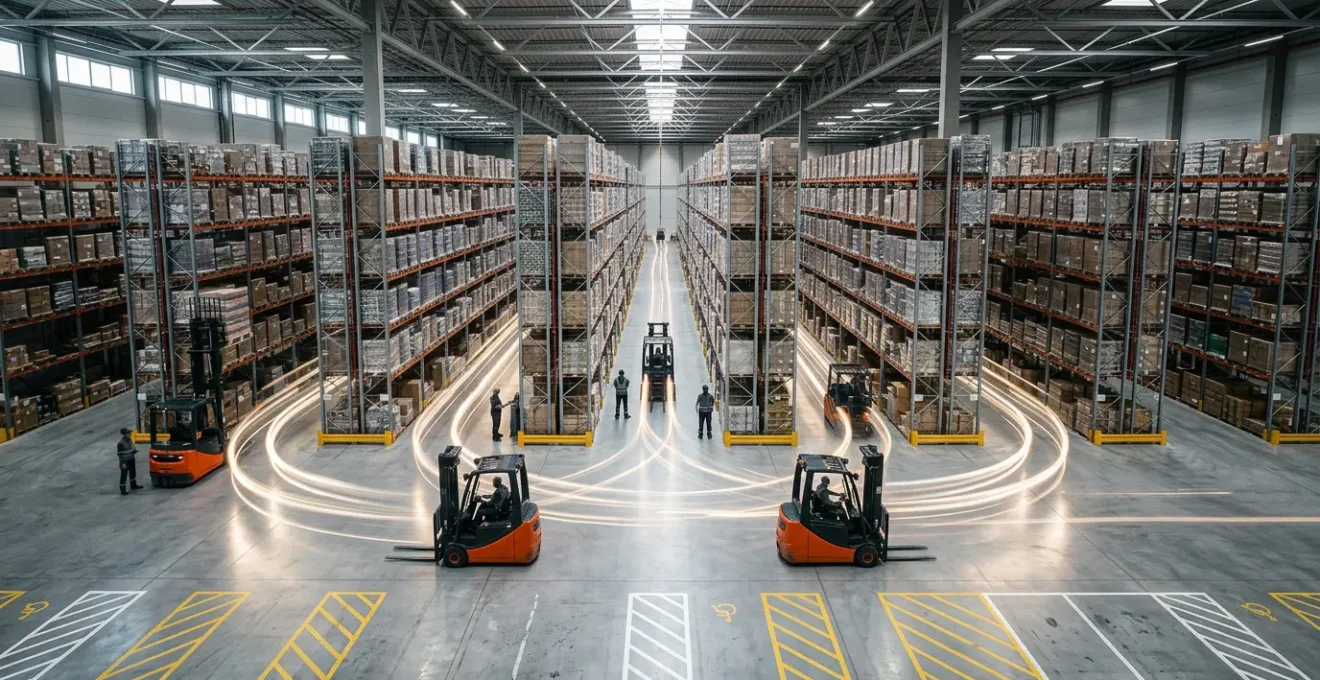
Resolving persistent warehouse bottlenecks requires shifting focus from fixing isolated jams to eliminating systemic throughput friction across your entire operation.
- Physical and data-flow blockages are symptoms of a disconnected system, not standalone problems.
- Strategic, phased technology adoption (like AMRs) and process re-engineering deliver higher ROI than reactionary, large-scale CAPEX.
Recommendation: Begin with a granular audit of your highest-friction processes—typically dispatch scanning and peak-hour scheduling—to identify the highest-impact, lowest-cost initial interventions.
For UK logistics directors, the promise of next-day delivery is a brutal, non-negotiable benchmark. Yet, many warehouses are sinking under the weight of their own operational complexity. The daily reality is a frustrating cycle of firefighting: pallet jams in the aisles, dispatch backlogs, and forklifts travelling miles to retrieve a single item. The common response is to throw more labour at the problem or consider a massive, disruptive overhaul of the Warehouse Management System (WMS). These are temporary patches on a systemic wound.
The conventional wisdom—optimise layouts, buy more scanners, train staff harder—scratches the surface but fails to address the core issue. These elements are treated as separate domains, when in reality they are deeply interconnected. A delay in one area creates a cascade of systemic friction that grinds the entire facility’s throughput velocity to a halt. The problem isn’t a single broken part; it’s the inefficient flow of data, goods, and people between those parts.
What if the key wasn’t simply investing in more technology, but in changing the fundamental operating model? This guide abandons the siloed, point-solution approach. We will dissect the warehouse as a single, integrated system. We will analyse the critical junctures where throughput friction originates—from the micro-level of a barcode scan to the macro-level of financing models—providing a practical, engineering-led framework to systematically isolate and eliminate bottlenecks for good.
This article provides a structured analysis of the most critical bottlenecks in modern logistics and presents data-driven strategies for their resolution. Explore the sections below to understand how to re-engineer your facility for maximum operational throughput.
Contents: Analysing and Resolving Critical Warehouse Choke Points
- Why Manual Barcode Scanning Slows Down Dispatch Operations by 40%?
- How to Redesign Warehouse Layouts to Minimise Forklift Travel Distance?
- Automated Conveyors vs Autonomous Mobile Robots: Which Clears Jams Faster?
- The Shift Scheduling Flaw That Causes Severe Peak Hour Congestion
- In What Order Should You Upgrade Legacy Sorting Machinery During Operations?
- How to Build Supply Chain Resilience Without Increasing Inventory Overhead?
- Why Delaying Smart Factory Investments Increases Energy Waste by 25%?
- Financing Industry 4.0 Upgrades for Traditional British Manufacturing Facilities
Why Manual Barcode Scanning Slows Down Dispatch Operations by 40%?
Manual barcode scanning is the definition of operational friction at a granular level. While seemingly a minor task, it is a critical choke point where the digital and physical supply chains meet. Every second a worker spends aligning a scanner, re-scanning a damaged label, or walking to a fixed terminal is a second of lost throughput velocity. These micro-delays compound exponentially across thousands of picks per day, creating significant backlogs at the dispatch bay. The core issue isn’t just the scanner; it’s the entire paper-based or manual process that forces linear, inefficient human movement.
The reliance on manual scanning directly anchors labour productivity to the physical limitations of an individual. This process is inherently prone to error, requires extensive training, and is difficult to scale during demand spikes. Research from Vecna Robotics reveals that while automation can deliver up to 40% efficiency gains, a staggering 76% of companies have not deployed even basic automated vehicles. This highlights a massive, industry-wide gap between known problems and implemented solutions.
The solution lies in decoupling the scanning event from manual labour wherever possible. Implementing RF-based processes, for example, has been shown to reduce unnecessary forklift travel by 27-37% compared to older, paper-based methods. This is because the data capture is integrated into the workflow, rather than being a separate, sequential step. By upgrading to systems like voice-picking, ring scanners, or fully automated robotic picking, the data capture becomes a seamless, background event, allowing human operators or machines to focus purely on the physical task of moving goods. This shift from active scanning to passive data capture is the first crucial step in reducing systemic friction at the point of origin.
How to Redesign Warehouse Layouts to Minimise Forklift Travel Distance?
An inefficient warehouse layout forces your most expensive assets—people and machinery—to burn time and fuel on non-value-added travel. Forklift operators navigating a maze of poorly placed SKUs are not just moving goods; they are generating waste. The objective of layout design is not aesthetic order but the ruthless minimisation of travel time between picking, packing, and dispatch. A poorly designed layout is a primary source of systemic friction, directly throttling your facility’s maximum throughput.
Identifying bottlenecks is the first step. This involves a granular data-driven audit, not just a visual inspection. To identify a bottleneck, you must « walk the floor » with a stopwatch and a process map, then validate your observations with WMS data. Look for areas with physical congestion, long queues of operators, or data showing excessive travel times for high-velocity items. The classic 80/20 rule often applies: 80% of travel time is spent retrieving just 20% of your fastest-moving SKUs. These items must be placed in the most accessible, ‘golden zone’ locations to slash travel distance.
Optimisation is an iterative, data-led process. It involves simulating changes before committing to costly physical relocations. Using digital twin technology, managers can model different layouts, test slotting strategies for high-velocity SKUs, and analyse heat maps of forklift traffic to predict and eliminate future choke points before they occur. This data-first approach transforms layout design from guesswork into a precise engineering discipline.
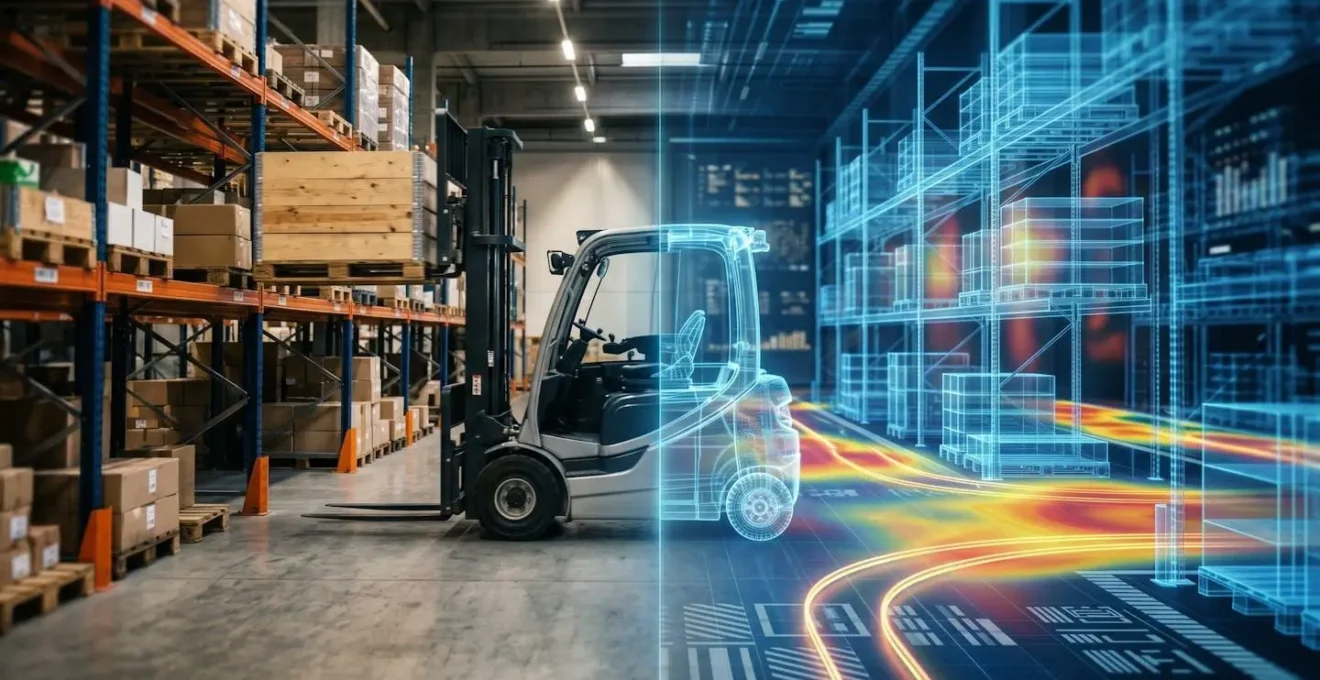
As the visualisation shows, a digital twin allows for the overlay of optimal path trajectories onto a virtual model of the warehouse. This simulation capability is essential for validating layout changes and ensuring they deliver a measurable reduction in travel distance and an increase in overall throughput velocity. The goal is to create a state of continuous flow, where every movement is purposeful and efficient.
Action Plan: The 5-Step Warehouse Layout Optimisation Process
- Conduct a detailed operational audit: Analyse order processing times, picking accuracy, storage utilisation, and labour efficiency to map existing workflow complexities and pinpoint specific friction points.
- Prioritise high-impact changes: Focus initial efforts on improving stock visibility, optimising storage layouts for fast-moving items, and reducing unnecessary product handling to achieve the highest returns first.
- Implement technology strategically: Deploy a modern WMS as the central nervous system to optimise inventory placement and integrate with automation tools for real-time visibility across all operations.
- Apply predictive analytics: Use AI tools to anticipate demand fluctuations, dynamically optimise picking routes in real-time, and proactively prevent bottlenecks before they materialise during peak hours.
- Measure KPIs continuously: Relentlessly track key metrics like order accuracy rate, inventory turnover, and order fulfillment speed to spot emerging inefficiencies and adjust strategies accordingly.
Automated Conveyors vs Autonomous Mobile Robots: Which Clears Jams Faster?
When goods movement is the bottleneck, automation is the obvious answer. However, the choice of technology dictates the facility’s flexibility and resilience. The two primary contenders are traditional fixed conveyor systems and modern Autonomous Mobile Robots (AMRs). While both move items, their operational philosophies are fundamentally different. Conveyors create a fixed, high-volume highway, while AMRs provide a flexible fleet of intelligent vehicles.
Before comparing, it’s crucial to distinguish between AGVs (Automated Guided Vehicles) and AMRs. AGVs are the predecessors, following fixed paths like magnetic tape or wires. They are rigid and stop when an obstacle is detected. AMRs, by contrast, use advanced sensors and AI to navigate dynamically, creating their own routes and safely maneuvering around obstacles. For clearing jams, this difference is critical: an AGV becomes part of the jam, while an AMR routes around it.
The key differentiator in clearing jams is intelligence and adaptability. A conveyor jam requires a full system stop and manual intervention, a catastrophic event for throughput. An AMR, faced with a blocked path, will communicate with the fleet management system and recalculate its route in milliseconds. This inherent ability to self-reroute makes AMR-driven facilities far more resilient to the small, unpredictable blockages that plague daily operations. The market is clearly shifting towards this flexibility, with an AMR market expected to achieve 30% CAGR, capturing over 20% of the warehouse automation market by 2028.
The following table, based on industry-wide performance data, breaks down the core differences in a head-to-head comparison. For managers focused on rapid deployment and scalable capacity, the metrics point heavily toward AMRs.
| Metric | Autonomous Mobile Robots (AMRs) | Conveyor Systems | Hybrid Solution |
|---|---|---|---|
| ROI Timeline | Under 24 months (250%+ ROI) | 4-6 years typical | 2-3 years |
| Deployment Speed | Weeks (no infrastructure) | 6-12 months | 3-6 months |
| Scalability | Highly scalable (RaaS model) | Fixed capacity | Moderate flexibility |
| Jam Resolution | Self-rerouting in milliseconds | Manual intervention required | Mixed automation |
| OPEX Reduction | 42% over 5 years | 25-30% after installation | 35% combined |
| Market Growth | 30% CAGR through 2028 | 8.5% CAGR | 15% CAGR |
The Shift Scheduling Flaw That Causes Severe Peak Hour Congestion
Peak hour congestion is often treated as an unavoidable cost of doing business, but it’s frequently a self-inflicted wound caused by flawed shift scheduling. The standard practice of starting all departments at the same time (e.g., everyone at 7 AM) creates an immediate, massive wave of demand on internal resources. Receiving is flooded, put-away teams have nowhere to go, and pickers are idle waiting for stock. This initial chaos ripples through the entire shift, creating hours of systemic friction.
The scale of this problem is significant. A 2024 Deloitte study reveals that 65% of warehouses struggle to scale labour for seasonal demands, a problem exacerbated by poor scheduling. The downstream effect is gridlock at the docks, with 63% of truck drivers reporting waits of three hours or more. This is not just an inconvenience; it’s a direct hit to your facility’s reputation and a massive operational cost.
The solution is to abandon synchronised start times in favour of function-based wave scheduling. This involves staggering start times by department to create a continuous, pull-based workflow. For example: Receiving starts at 6:00 AM, the Put-away team starts at 6:45 AM to handle the initial inflow of goods, and the Picking team starts at 7:30 AM when the first wave of inventory is already on the shelves. This simple change smooths out the initial demand spike and creates a steady operational rhythm. Further gains can be made by implementing rolling break schedules to maintain a baseline operational capacity throughout the day, avoiding the dead-stop of a synchronised lunch break.
Advanced scheduling connects directly to predictive analytics. By using incoming order data to forecast labour needs 4-8 hours in advance, managers can dynamically reallocate cross-trained staff to emerging bottlenecks before they become critical. This transforms scheduling from a static, weekly plan into a dynamic, real-time lever for controlling throughput.
In What Order Should You Upgrade Legacy Sorting Machinery During Operations?
The temptation to replace aging sorting machinery with a state-of-the-art, fully automated system is strong. However, a « big bang » implementation is high-risk, high-cost, and almost guarantees operational disruption. A more pragmatic, engineering-led approach is phased modernization. This involves a strategic, sequential upgrade of components that aligns with your operational priorities and budget, allowing the facility to remain productive throughout the transition.
The absolute first principle of any upgrade is to fix the process before you automate it. Automating a broken, inefficient workflow only creates faster, more expensive chaos. The upgrade sequence must therefore begin not with machinery, but with data.
Case Study: The « Process First » Mandate
Based on 30 years of experience, automation integrator PeakLogix emphasizes that all successful implementations begin with detailed time studies and workflow analysis. Their critical lesson is that attempting to automate a flawed process invariably leads to expensive complications and failed ROI. They advocate for fixing the underlying workflow first. For many mid-sized operations, this means starting with flexible solutions like AMRs, which can be deployed quickly to improve an existing process, and then scaled over time as other parts of the system are optimized. This phased approach, starting with process and followed by scalable tech, minimises risk and ensures technology serves the operation, not the other way around.
The logical upgrade sequence should therefore be:
- Data & Control Systems: First, upgrade the WMS or invest in a Warehouse Control System (WCS) that can provide granular data and integrate with modern hardware. Without a robust digital « nervous system, » new machinery is useless.
- Highest-Friction Points: Identify and replace the single component causing the most significant delays. This might be a slow divert on a conveyor or an outdated labeling machine. A small, targeted upgrade can yield a disproportionately large improvement in throughput.
- Modular Integration: Favour modular, scalable technologies over monolithic systems. Replace a section of a conveyor with a robotic sorter or integrate AMRs to handle specific routes. This allows for incremental investment and continuous improvement without shutting down the entire line.
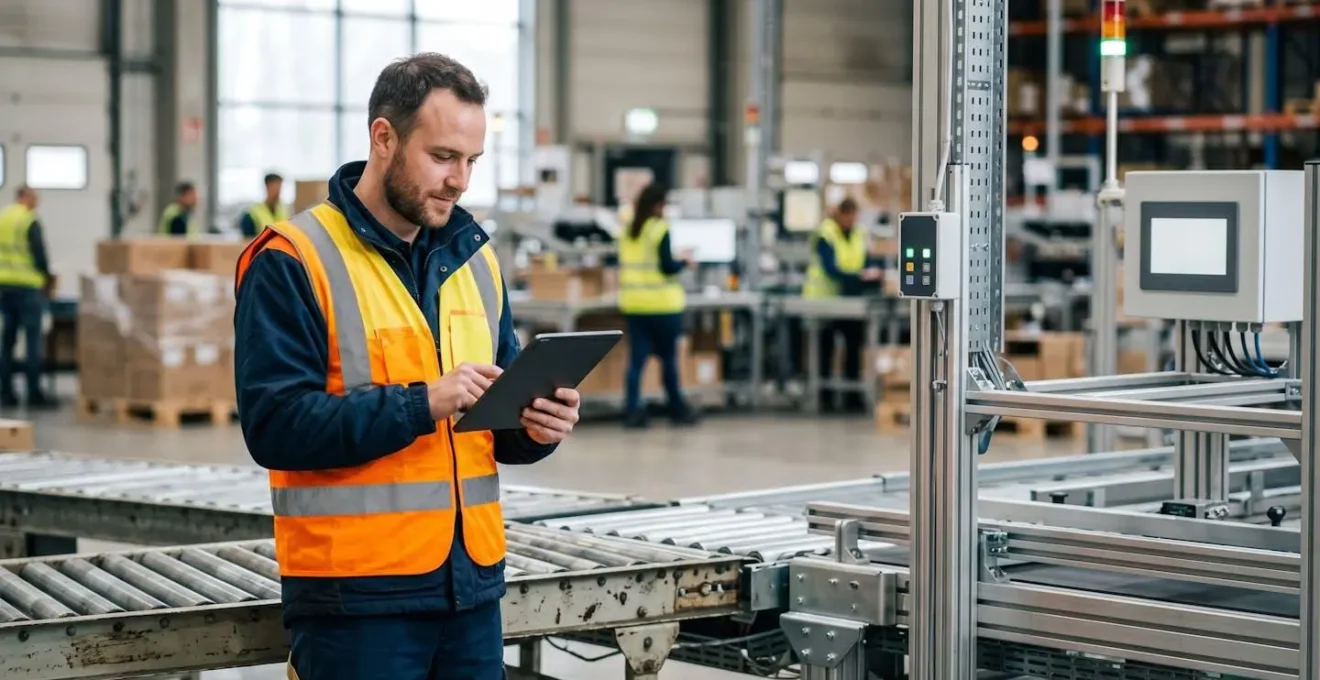
This approach allows workers to adapt to new systems progressively, as shown above, minimising training overhead and resistance to change. It transforms a daunting, capital-intensive overhaul into a manageable series of tactical improvements that deliver immediate and compounding value.
How to Build Supply Chain Resilience Without Increasing Inventory Overhead?
Traditional wisdom dictates that resilience is built on inventory: more stock equals a bigger buffer against disruption. In today’s high-velocity, low-margin environment, this is a flawed and expensive strategy. Bloated inventory ties up capital, increases holding costs, and masks underlying process inefficiencies. True resilience is not about having more « stuff »; it’s about building a more agile, flexible, and visible operation that can adapt to disruptions in real-time.
The biggest overhead in most warehouses isn’t inventory, it’s labour. With labour comprising 50-70% of warehousing budgets and wages climbing, the most effective way to build a resilient, cost-effective operation is to maximise the productivity of your existing workforce and infrastructure. Resilience, therefore, becomes a function of operational flexibility.
Key strategies for building process-led resilience include:
- Real-Time Data Visibility: A modern WMS with clear dashboards is the cornerstone of resilience. When you can see inventory levels, fulfillment status, and workflows in real-time, you can proactively prevent stockouts and overstocking without carrying excess safety stock.
- Cross-Functional Workforce: The most flexible asset you have is your people. By implementing a skills matrix and actively cross-training your workforce, you create the ability to dynamically reallocate staff to bottlenecks as they emerge, whether due to a demand spike or unexpected staff shortages.
- Postponement Strategy: This involves delaying the final configuration or packaging of a product until the last possible moment. By holding generic, semi-finished goods, a single pool of inventory can be used to fulfill a wider variety of final orders, dramatically increasing flexibility without increasing total stock.
- Modular Automation: As discussed previously, deploying flexible systems like AMRs that can be rerouted to different tasks (e.g., from put-away to picking support) provides a layer of resilience that fixed conveyor systems cannot match.
By focusing on these process-driven initiatives, logistics directors can build a far more robust and responsive supply chain at a fraction of the cost of simply increasing inventory levels. This shifts the focus from absorbing shocks with expensive buffers to nimbly adapting to them with superior processes.
Why Delaying Smart Factory Investments Increases Energy Waste by 25%?
The decision to delay investment in Industry 4.0 technology is often framed as a CAPEX-saving measure. In reality, it’s an acceptance of ongoing, escalating OPEX waste, particularly in energy consumption. An « un-smart » warehouse is an inefficient one, filled with machinery that runs when it doesn’t need to, forklifts that take suboptimal routes, and lighting and HVAC systems that operate at full power in empty zones. This accumulated waste can easily account for a significant portion of a facility’s energy bill.
The industry is moving decisively towards smart technology. The MHI 2024 Annual Report indicates that 85% of supply chain leaders plan to adopt AI technologies within five years, with adoption already high in large warehouses. Delaying investment is not just deferring a cost; it’s actively falling behind the industry standard for operational efficiency and sustainability.
Smart factory technology, particularly solutions powered by IoT and AI, directly combats energy waste. For instance, predictive maintenance is a key component. McKinsey reports that this technology reduces machine downtime by 30-40% and, crucially, extends equipment lifespan by 20-40%. Less downtime and longer life mean less energy wasted on idle or failing machinery and a lower carbon footprint from manufacturing replacements. The same report notes that smart warehouse implementations can lead to a 13% reduction in maintenance costs and a 15% overall efficiency increase.
This efficiency translates directly into energy savings. AI-optimised routing algorithms for AMRs and forklifts ensure the shortest possible travel distance, reducing fuel and electricity consumption. IoT sensors can enable smart lighting and climate control that power down sections of the warehouse when unoccupied. While the title’s 25% figure is illustrative, the principle is sound: every inefficiency in your process—every extra metre travelled, every minute of idle time—is a quantifiable unit of wasted energy. Delaying the smart technology that eliminates this waste is a direct decision to continue paying for it.
Key Takeaways
- Systemic friction, not isolated incidents, is the true cause of warehouse bottlenecks. A holistic, engineering-led approach is required.
- Phased, data-driven modernization focusing on flexible automation like AMRs yields higher ROI and less disruption than large, monolithic upgrades.
- True supply chain resilience is built on process flexibility (visibility, cross-training, postponement) not expensive inventory overhead.
Financing Industry 4.0 Upgrades for Traditional British Manufacturing Facilities
For many traditional British manufacturing and logistics facilities, the primary barrier to Industry 4.0 adoption is not a lack of will, but the perception of prohibitive upfront cost. The traditional Capital Expenditure (CAPEX) model, requiring millions of pounds for new infrastructure, is simply not viable for many businesses, especially when facing uncertain demand. However, the financing landscape has evolved, and several OPEX-based models now make advanced automation accessible without crippling the balance sheet.
The most transformative of these is Robotics-as-a-Service (RaaS). In this model, a warehouse operator pays a monthly or quarterly subscription fee to a third-party provider. This fee covers the deployment, maintenance, and upgrading of the robotic fleet. It shifts the financial burden from a massive one-time purchase to a predictable operational expense. This model is gaining significant traction, with ABI Research predicting that 72% of logistics firms plan RaaS contracts, driving 1.3 million installations by 2026.
The RaaS model de-risks technology investment. The provider, not the warehouse, is responsible for ensuring the technology remains current and functional. It also provides unmatched scalability; a facility can increase or decrease its robotic capacity to match seasonal demand, paying only for what it uses. This is a level of flexibility that is impossible to achieve with a fixed CAPEX investment in conveyors or sorters.
For UK distribution centres, the choice between financing models has a direct impact on competitiveness and agility. The table below outlines the primary options, highlighting how newer models like RaaS offer a faster path to ROI and significantly lower risk.
| Financing Model | Initial Investment | Payback Period | Flexibility | Risk Level |
|---|---|---|---|---|
| Traditional CAPEX | £2-5 million upfront | 4-6 years | Low – fixed infrastructure | High – technology obsolescence |
| Robotics-as-a-Service (RaaS) | Minimal upfront | Under 24 months | High – scalable capacity | Low – provider maintains |
| Hybrid Lease Model | 20-30% down | 2-3 years | Moderate | Moderate |
| Performance-based | None – gain sharing | Immediate ROI | Very high | Minimal – tied to results |
Now that the operational and financial frameworks are clear, the next logical step is to build a business case for a phased modernization project. Start by benchmarking your highest-friction process and modeling the ROI of a targeted RaaS deployment.