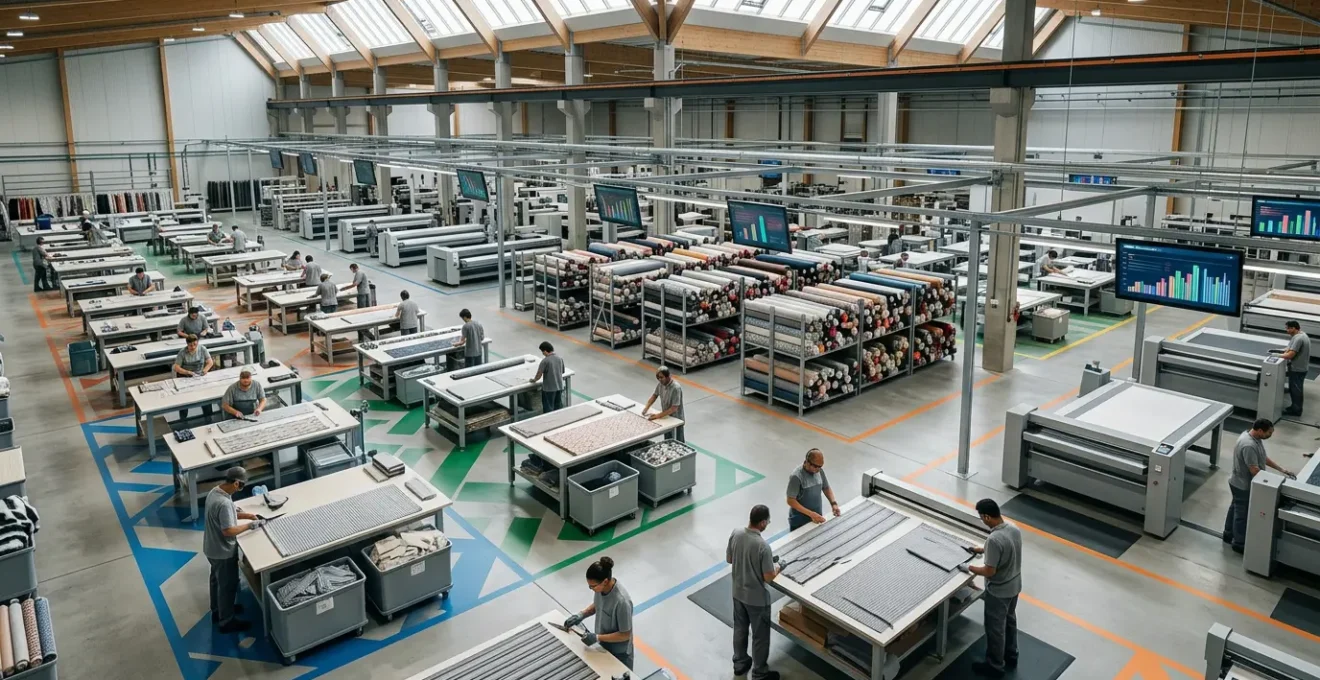
The pervasive waste in textile manufacturing is not a cost of doing business; it is a critical, and correctable, systems failure.
- Data-driven tools like AI-powered cutting and predictive maintenance can reduce material defects and yardage waste by over 40%.
- Addressing overproduction and mapping your value stream are the most effective levers for reducing unsellable stock and slashing lead times.
Recommendation: Begin by conducting a rigorous Value Stream Mapping (VSM) session to identify the most significant sources of waste (Muda) in your current process.
For Production Directors and Sustainability Leads in the UK’s fashion sector, the pressure is immense. The mandate is dual-pronged and seemingly contradictory: slash operational costs while simultaneously meeting aggressive environmental targets. The common approach often involves surface-level initiatives—basic recycling programmes or generic staff training. These are well-intentioned but fundamentally flawed, as they treat the symptoms of waste, not the cause. They accept waste as an inevitable byproduct of production.
This is a strategic error. The true path to minimising waste and maximising margins lies in a far more disciplined philosophy. But what if the key was not merely managing waste after it’s created, but engineering it out of the system entirely? This is the core tenet of Lean Manufacturing. It reframes waste (or ‘Muda’) not as an operational reality, but as a quantifiable systems failure—a direct drain on profitability and efficiency that must be systematically hunted and eliminated.
This article provides a zero-tolerance framework for waste. We will dissect the operational DNA of textile production, from the first cut of fabric to the final logistics. We will move beyond platitudes to provide data-driven tactics for identifying and eradicating the seven forms of waste. This guide will demonstrate how to implement aggressive lean techniques to transform your production line into a model of ruthless efficiency, satisfying both your balance sheet and your regulatory obligations.
This guide provides a structured analysis of the primary sources of waste in textile manufacturing and the specific Lean methodologies required to eliminate them. The following sections offer a comprehensive roadmap for transforming your operations.
Summary: A Lean Framework for Eliminating Waste in UK Textile Production
- Why Poor Fabric Cutting Algorithms Cost Fashion Brands Over £100,000 Annually?
- How to Repurpose Textile Offcuts Into Profitable Secondary Product Lines?
- Preventative Maintenance vs Run-to-Failure: Which Reduces Defective Yardage?
- The Overproduction Mistake That Fills Warehouses With Unsellable Seasonal Stock
- The Optimal Frequency for Conducting Value Stream Mapping Sessions
- How to Calculate Scope 3 Emissions Accurately Across Your Entire Supply Chain?
- How to Measure Electricity Consumption Accurately Per Production Batch?
- Tracking and Reducing Industrial Emissions for UK Regulatory Compliance
Why Poor Fabric Cutting Algorithms Cost Fashion Brands Over £100,000 Annually?
The single greatest point of material waste in garment production occurs before the first stitch is ever sewn: the cutting room. Inefficient marker making and poor nesting algorithms are a direct and catastrophic drain on resources. For many facilities, this is a blind spot, accepted as the « cost of doing business. » This is an unacceptable view. Analysis shows that on average, 15% of fabric used in garment manufacturing is wasted during the cutting phase. For a medium-sized UK operation, this easily translates into losses exceeding £100,000 per year, purely in discarded raw material. This figure doesn’t even account for the associated disposal costs and the embedded carbon footprint of that wasted fabric.
The issue stems from a failure to treat fabric utilisation as a key performance indicator. Sub-optimal manual layouts or outdated software simply cannot compute the millions of pattern combinations required to achieve maximum efficiency. Modern digital pattern nesting software, especially those enhanced with AI optimisation, consistently outperform human operators and older systems, pushing fabric utilisation rates from a typical 80-85% towards the lean benchmark of 90% or higher. A 5% improvement in fabric yield drops directly to the bottom line.
Achieving this requires a systematic approach. It is not merely a software upgrade but a process overhaul. The goal is to create a closed feedback loop where design choices are informed by cutting efficiency. Key steps to operationalise this include:
- Measure Current Efficiency: Establish a baseline. The industry benchmark for fabric utilisation is around 87%. Anything less is a clear signal of a significant systems failure.
- Implement Digital Nesting Software: Invest in modern tools that use AI to optimise pattern placement in real-time.
- Train Operators on Waste Minimisation: Operators must understand the financial and environmental cost of every centimetre of fabric.
- Monitor Real-Time Usage: Utilise IoT sensors on cutting machines to track fabric consumption against expected yield for every single job.
- Create Design-to-Cutting Feedback Loops: Ensure designers are aware of how minor pattern adjustments can dramatically impact material yield.
This isn’t just about saving fabric; it’s about re-engineering the first, and most critical, stage of production for maximum value extraction. The financial case is undeniable, and the reduction in raw material consumption is a significant step toward sustainability goals.
How to Repurpose Textile Offcuts Into Profitable Secondary Product Lines?
Even in the most optimised cutting rooms, some level of offcut waste is unavoidable. The traditional approach is to discard this material, sending it to landfill or incineration—a total loss of value. A lean approach, however, sees these offcuts not as waste but as unrealised inventory. The challenge is to create a system that captures this value efficiently. Globally, the statistics are damning: only 12% of textile material used for clothing ends up being recycled, representing a colossal failure in imagination and process.
Repurposing offcuts requires a shift in mindset from a linear « take-make-dispose » model to a circular one. This begins with rigorous sorting. Offcuts must be segregated immediately at the point of creation by material type, colour, and size. This discipline is crucial, as mixed textile waste has virtually no resale value, whereas sorted, clean materials can become feedstock for new products.

Once sorted, several profitable avenues open up. Larger offcuts can be used for smaller items like accessories, children’s clothing, or component parts (pockets, collars). Smaller scraps can be shredded to create insulation, stuffing for furniture, or industrial cleaning cloths. Some companies have even built entire, profitable secondary brands based on upcycling their primary production « waste ». The key is to design this secondary process with the same rigour as the primary one, analysing potential markets and ensuring the cost of collection and sorting is outweighed by the revenue generated. This transforms a cost centre (waste disposal) into a profit centre.
Preventative Maintenance vs Run-to-Failure: Which Reduces Defective Yardage?
Waste is not limited to discarded fabric scraps. A far more insidious form is the waste of defects (Muda of Defects), where entire rolls of fabric or batches of finished garments are rendered unsellable due to machine malfunction. This is a direct consequence of a flawed maintenance strategy. The « run-to-failure » approach, where machines are used until they break down, is the antithesis of lean. It guarantees unplanned downtime, emergency repair costs, and, most critically, a high rate of defective output as machine performance degrades unnoticed.
Preventative maintenance, based on scheduled servicing, is a significant improvement. It reduces catastrophic failures and allows for planned downtime. However, it is still inefficient. It can lead to over-servicing of healthy machines or fail to catch an unexpected issue between cycles. The truly lean approach is predictive maintenance (PdM), which uses IoT sensors and data analysis to monitor machine health in real-time. By tracking variables like temperature, vibration, and energy consumption, PdM algorithms can predict failures before they occur, allowing for hyper-targeted maintenance exactly when it’s needed.
The impact on defect reduction is dramatic. A run-to-failure model does nothing to prevent defects, while a predictive model can pre-empt the machine misalignments, tension issues, or blade dullness that cause flaws in the fabric. As one study in the International Journal of Advanced Manufacturing Technology highlights, the application of lean tools directly impacts quality control:
Application of tools such as Value Stream Mapping (VSM), 5S, and cellular manufacturing has increased production output by 17.8%, improved efficiency by 12.46%, reduced defect rates (e.g., from 12.7% to 6.71% in cutting processes)
– International Journal of Advanced Manufacturing Technology, Applications of lean manufacturing in textile garments industry
This data proves that investing in a robust maintenance framework is a direct investment in quality and waste reduction. The choice is not merely operational, but strategic, with clear financial implications as outlined in the comparison below.
| Maintenance Type | Cost Impact | Defect Rate Reduction | Implementation Complexity |
|---|---|---|---|
| Run-to-Failure | High emergency repair costs | 0% (baseline) | Low |
| Preventative Maintenance | Moderate scheduled costs | 30-40% reduction | Medium |
| Predictive Maintenance (IoT) | Lower long-term costs | 60-70% reduction | High initially |
The Overproduction Mistake That Fills Warehouses With Unsellable Seasonal Stock
In lean philosophy, overproduction is considered the most dangerous of the seven wastes. It is the ‘mother of all wastes’ because it generates all the others: excess inventory, unnecessary transportation, defects found long after production, and the massive capital cost of warehousing unsellable goods. The fast-fashion model, with its reliance on trend forecasting and large batch production, is systemically prone to this error. The data is stark: some industry data reveals that 60% of 150 million garments produced in a single year were discarded within a few years, much of it never having been sold at full price.
This is a direct failure of production strategy. Manufacturing large batches based on forecasts, rather than actual demand, creates enormous risk. A single missed trend can result in millions of pounds of deadstock that must be discounted, exported, or destroyed. The lean solution is to shift towards a Just-In-Time (JIT) or pull-based system. Instead of pushing large batches through production, a pull system produces smaller quantities in response to real customer orders. This drastically reduces the risk of overproduction and slashes the amount of Work-In-Progress (WIP) on the factory floor.
Implementing this requires a radical redesign of the production layout, moving from siloed departments to flexible manufacturing cells. One case study on lean implementation demonstrated that by modifying the production layout, it was possible to achieve a WIP reduction of over 80%. This not only frees up enormous amounts of working capital tied up in inventory but also makes the entire operation more agile. With smaller batch sizes, the company can respond faster to changing market trends, pivot to more popular items, and avoid the catastrophic write-downs associated with seasonal deadstock. The focus shifts from ‘producing as much as possible’ to ‘producing only what is needed, exactly when it is needed’.
The Optimal Frequency for Conducting Value Stream Mapping Sessions
You cannot eliminate waste that you cannot see. The primary diagnostic tool in the lean arsenal for making waste visible is Value Stream Mapping (VSM). A VSM is an intensive, collaborative exercise where a team walks the entire production path, from raw material delivery to final shipping, mapping every single step. For each step, they ask a critical question: « Does this add value for the customer? » Any step that does not—waiting, moving, inspecting, counting—is identified as waste (Muda) and targeted for elimination. It is the foundational activity for any serious lean transformation.
The question is not whether to do VSM, but how often. A VSM is not a one-time event. It is a cyclical process of diagnosis, improvement (Kaizen), and re-evaluation. A common error is to conduct a single VSM, create a « future state » map, and then consider the job done. This fails to account for market changes, new technologies, and the natural tendency for processes to degrade over time. The optimal frequency depends on the velocity of your business, but a general rule is to conduct a full, strategic VSM at least annually. For critical or problematic production lines, more frequent, focused VSMs should be conducted on a quarterly or semi-annual basis.

The results of disciplined VSM are profound. It provides the data needed to justify investments and reorganise workflows. A case study documented by researchers on VSM at an apparel company showed that by mapping the current state and designing a future state, the total lead time for an outerwear garment could be slashed from 27-33 weeks down to a target of 9-14 weeks. This is not an incremental improvement; it is a fundamental transformation of the business’s ability to respond to market demand, driven by the simple act of making the entire value stream visible to those empowered to change it.
How to Calculate Scope 3 Emissions Accurately Across Your Entire Supply Chain?
For a sustainability lead, waste is synonymous with emissions. In the textile industry, the vast majority of environmental impact lies not within your own four walls (Scope 1 & 2), but deep within your supply chain (Scope 3). Analysis from Boston Consulting Group shows that a staggering 92% of the fashion industry’s greenhouse gas emissions come from upstream activities like raw material production, spinning, weaving, and dyeing. Ignoring this is to ignore the biggest piece of the puzzle. Accurately calculating these emissions is the first step toward managing and reducing them.
This calculation is a complex data-gathering exercise. It requires moving beyond a transactional relationship with suppliers to a transparent partnership. You need granular data from every tier. This means knowing not just where your fabric comes from, but where the yarn was spun, where the cotton was grown, and how much energy and water were consumed at each stage. This level of traceability is no longer optional; it is becoming a requirement for regulatory compliance and consumer trust. Emerging technologies like blockchain and Digital Product Passports (DPP) are becoming essential tools for collecting and verifying this data at scale.
The process is methodical and requires a clear action plan. Without a structured approach, the task is overwhelming. The following checklist, based on the GHG Protocol for Scope 3 emissions, provides a high-level framework for any textile company beginning this journey. It is a non-negotiable process for any brand serious about its environmental claims.
Action Plan: Auditing Your Scope 3 Supply Chain Emissions
- Map all Tier 1, 2, and 3 suppliers across the entire textile value chain to identify all actors.
- Collect primary energy and water consumption data directly from dyeing, printing, and finishing partners.
- Track all transportation and logistics emissions between every production stage, from farm to factory to warehouse.
- Calculate the embedded emissions in raw materials using industry-standard databases (e.g., Higg Index) for cotton, polyester, etc.
- Aggregate all collected data using a recognised framework, primarily the GHG Protocol’s Scope 3 categories, to ensure standardised reporting.
How to Measure Electricity Consumption Accurately Per Production Batch?
Beyond material and defects, a significant and often overlooked waste is the consumption of utilities—specifically, electricity. Most factories track overall energy usage for billing purposes but lack the granularity to understand consumption at a process or per-batch level. This is a missed opportunity for efficiency gains. Without precise measurement, it’s impossible to know if a specific machine is inefficient, if an operator is using a suboptimal process, or how much energy is consumed during idle periods. In an era of volatile energy prices, this ignorance is a direct financial liability.
The solution is sub-metering and real-time monitoring. By installing smart meters on individual production lines or even specific high-consumption machines (e.g., dyeing machines, large cutters, steam presses), you can gain a precise understanding of your energy profile. This data allows you to allocate energy costs accurately to each production batch, providing a truer picture of its total cost. More importantly, it highlights anomalies. A sudden spike in consumption on a particular machine can be an early warning sign of a mechanical issue, tying directly into a predictive maintenance strategy.
This focus on granular efficiency extends beyond electricity. The textile industry is notoriously water-intensive. Estimates suggest the textile industry consumes an estimated 79 billion cubic meters of water annually, primarily in wet processing stages like dyeing and finishing. Measuring consumption per batch allows for the implementation of process improvements, such as low-water dyeing techniques or water recycling systems, with a clear ROI calculation. By treating utilities not as a fixed overhead but as a variable input cost, you empower your team to manage and reduce it with the same discipline applied to fabric or labour.
Key Takeaways
- Inefficient cutting processes are a primary source of financial loss, often costing over £100,000 annually through fabric waste that can exceed 15% of total material.
- Predictive maintenance is superior to preventative or run-to-failure models, capable of reducing defective yardage by up to 70% by pre-empting machine-induced errors.
- The greatest waste is overproduction; implementing lean principles to reduce Work-In-Progress (WIP) and better align with demand is more critical than recycling post-production waste.
Tracking and Reducing Industrial Emissions for UK Regulatory Compliance
For UK-based manufacturers, the drive to reduce waste and emissions is no longer just a matter of corporate social responsibility or cost savings. It is a legal and regulatory imperative. The UK government and its trading partners are enacting increasingly stringent environmental reporting standards, and failure to comply carries significant financial and reputational risk. The days of treating emissions and waste data as a secondary concern are over. It must be managed with the same rigour as financial accounting.
The scale of the problem within the UK is significant; UK waste management data shows an estimated 350,000 tonnes of clothing waste is sent to landfill annually. This figure is on the radar of regulators, who are now using a multi-layered approach to enforce corporate accountability. Key regulations that production directors must have on their dashboard include the Streamlined Energy and Carbon Reporting (SECR) framework, which mandates energy and emissions disclosure for large companies, and the recommendations of the Task Force on Climate-related Financial Disclosures (TCFD) for listed entities.
Furthermore, for businesses exporting to the EU, the Carbon Border Adjustment Mechanism (CBAM) is a game-changer. It effectively puts a price on the carbon embedded in imported goods, making it essential to have verifiable data on the emissions footprint of your products. A lack of accurate data will lead to default penalties and a loss of competitive advantage. This regulatory landscape makes a disciplined, lean approach to data collection and waste reduction a prerequisite for market access.
| Regulation | Scope | Key Requirements | Reporting Frequency |
|---|---|---|---|
| SECR | Large companies | Energy use, GHG emissions | Annual |
| TCFD | Listed companies | Climate risk disclosure | Annual |
| CBAM (for EU exports) | Carbon-intensive goods | Embedded emissions reporting | Quarterly |
The implementation of a lean framework is a journey of continuous improvement, not a final destination. By adopting a zero-tolerance policy for all forms of waste—material, defects, energy, and overproduction—you transform your operation from a cost-driven machine into a value-driven system. This disciplined approach is the most effective strategy for simultaneously boosting profitability and meeting the stringent demands of the modern regulatory and consumer landscape.